

 Global| Nov 18 2026
Credibility in an Age of Supply Shocks
by:Andrew Cates
|in:Viewpoints
Central banks cannot produce oil. They can make borrowing dearer, weaken spending and persuade businesses that inflation will not be tolerated. The distinction matters. When prices rise because supply has been disrupted, restoring stability may require patience as well as resolve. Confusing the two can impose needless costs and squander the credibility monetary policy depends upon.
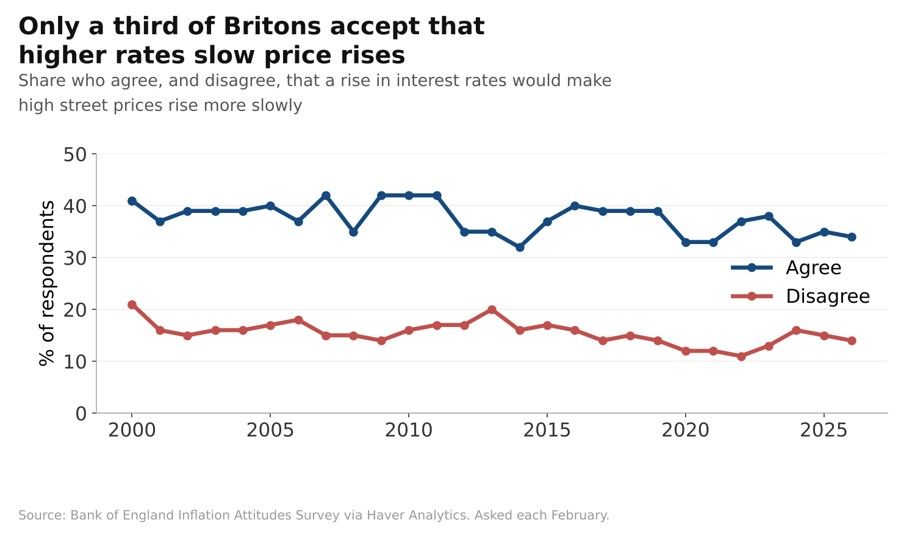
The public is already sceptical. The Bank of England’s long-running survey finds that only about a third of Britons accept that higher interest rates will slow price rises. American research reveals a similar gulf between economists and households. The survey in Exhibit 1 is striking less for any individual reading than for how little attitudes have changed through successive monetary cycles.
Exhibit 1 Public beliefs about interest rates and inflation
This is not simply a failure of education. A household whose mortgage payment rises after an interest-rate increase has experienced a higher cost of living. The economist is describing what should eventually happen to inflation across the economy. The borrower is describing what has already happened to the family budget. Both can be right.
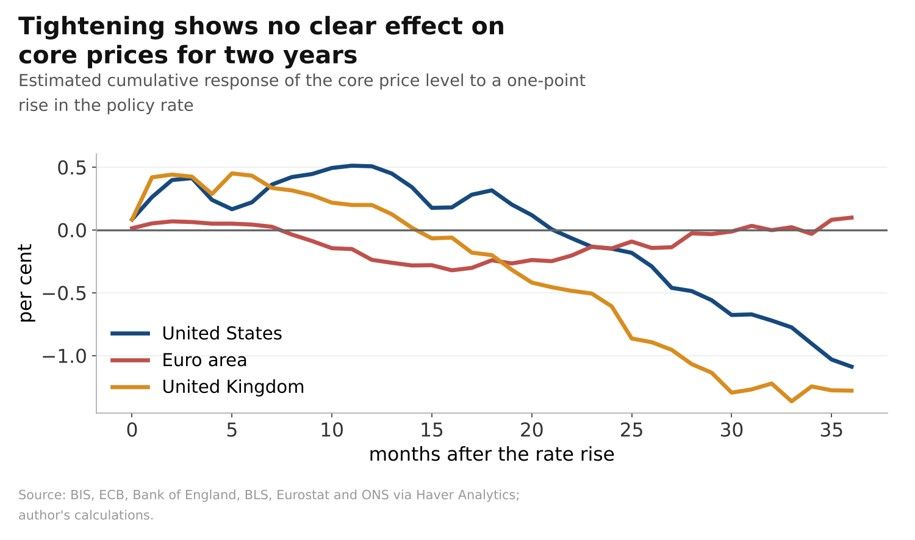
Nor is the evidence as simple as the textbook account suggests. The estimates in Exhibit 2 struggle to identify a clear fall in core prices after monetary tightening. That is a reason for caution about the timing and size of the effect, not proof that interest rates are powerless. Policy responds to the very inflation it seeks to control, and separating cause from response is difficult.
Exhibit 2 Estimated response of core prices to monetary tightening
The case for monetary restraint nevertheless rests on a straightforward mechanism. Dearer credit curbs spending and investment. Weaker demand reduces employers’ need to recruit and firms’ ability to raise prices. Eventually, wage and price pressures ease. This can be essential when an economy is spending beyond its capacity to supply.
An energy shock presents a different problem. It makes a necessary import more expensive and leaves households with less to spend elsewhere. The country has become poorer. Raising interest rates cannot remove that loss. It can add to it by depressing domestic activity until other prices rise slowly enough to offset the imported increase.
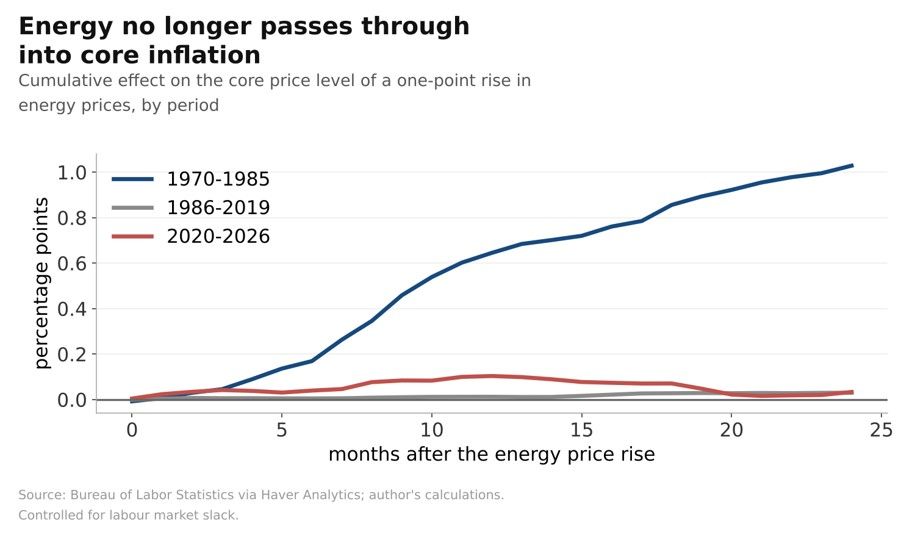
The crucial question is whether the initial shock becomes persistent inflation. A rise in energy prices need not produce an indefinite rise in the general price level. It does so only if wages and prices chase one another, spending remains strong and expectations adjust upwards. Exhibit 3 suggests that this transmission has weakened markedly since the 1970s. The origin of a shock does not excuse indifference to its consequences, but it should shape the response.
Exhibit 3 Energy pass through to core prices across periods
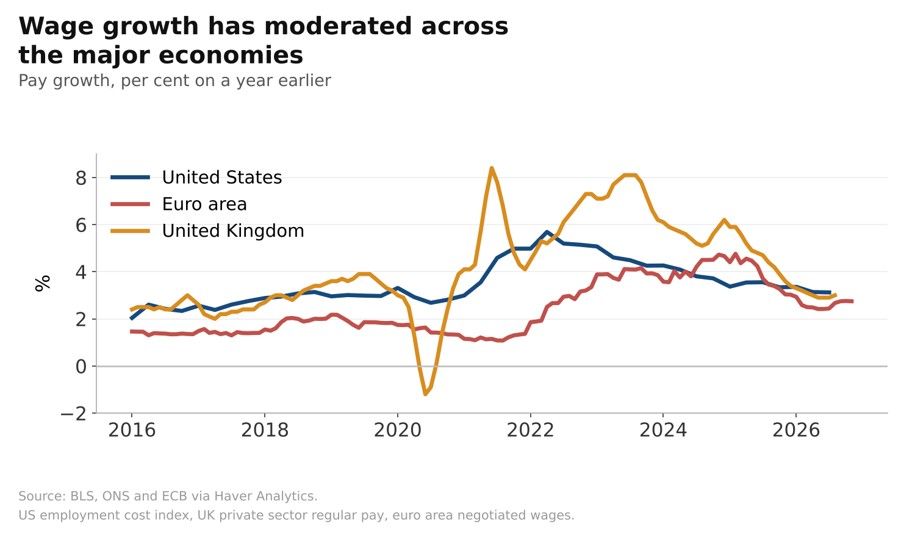
This distinction is particularly important now. Energy accounts for the renewed pressure on headline inflation, while the labour-market and monetary indicators offer much less evidence of a domestic boom. Wage growth has moderated across the major economies, as Exhibit 4 shows. Money growth has returned towards more ordinary rates. The story is of an economy absorbing a loss of purchasing power, rather than one obviously generating an excess of demand.
Exhibit 4 Wage and labour cost indicators
That judgement needs qualification. British productivity remains weak, so even modest wage growth can put pressure on costs. And the absence of pressure today does not guarantee its absence tomorrow. These are reasons to monitor the evidence, rather than to assume that every rise in headline inflation demands another rise in rates.
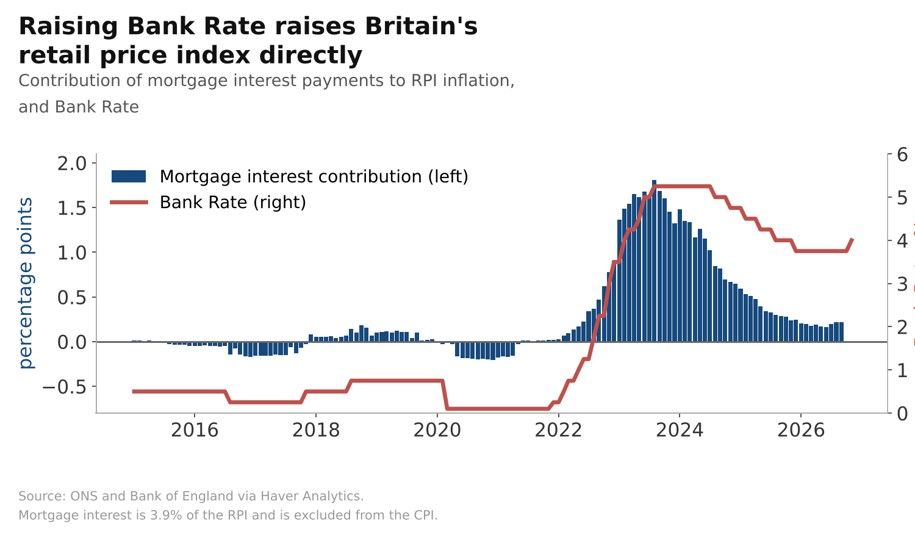
Housing makes the public explanation harder still. Mortgage interest enters Britain’s retail price index directly, as Exhibit 5 shows, although the Bank targets a measure that excludes it. American shelter costs enter the consumer price index through rents and imputed rents. The gap between what households experience and the measures policymakers discuss is wide, and it widens precisely when rates rise.
Exhibit 5 Housing costs and the tightening cycle
A stronger currency can offer relief by reducing import prices. Yet the exchange-rate response to interest rates is uncertain. Moreover, the major economies cannot all appreciate against one another. If each tightens to escape the same external shock, the collective result may be weaker demand with little relief from the original disruption.
The policy rate is also not the only instrument that has been tightening. Central banks spent the past decade accumulating government bonds, and they have spent the past three years letting them run off. Measured against national income, the balance sheets of the Federal Reserve, the European Central Bank and the Bank of England have each contracted substantially from their peaks. The euro area’s is now smaller, relative to output, than it was before the pandemic.
The relationship between these balance sheets and real long-term interest rates is close, and it runs in the direction theory implies: when central banks hold more of the outstanding stock of bonds, real yields are lower. The association survives the more demanding test of measurement in changes rather than levels, though it is loosely estimated and causation runs both ways.
Exhibit 6 Central bank balance sheets and real interest rates
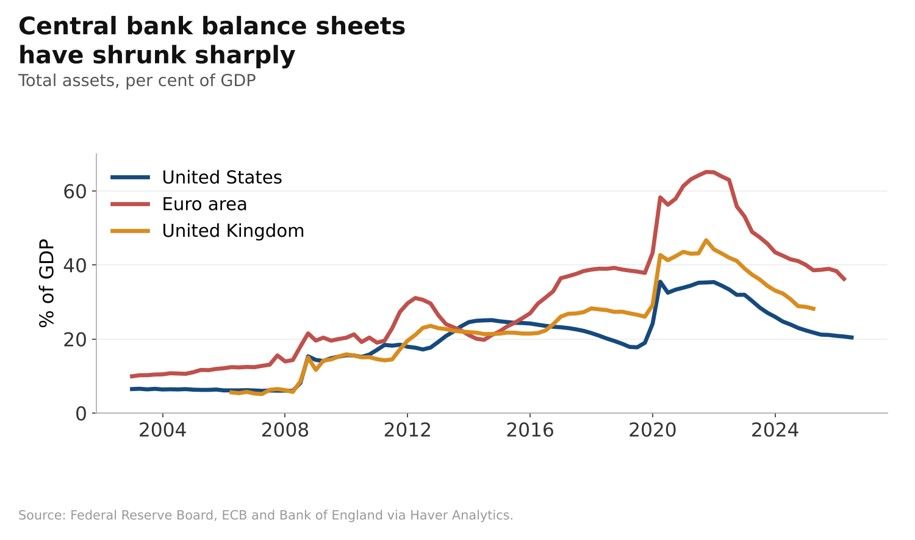
The implication is worth stating. Assessments of whether policy is restrictive almost always rest on the policy rate alone. Including the balance sheet makes current settings look tighter than the headline rate suggests, and by an amount that is not trivial.
Running down a balance sheet also withdraws reserves from the banking system, and it is doing so while credit migrates towards institutions outside the conventional banking perimeter. That combination deserves attention on financial-stability grounds, quite apart from what it does to inflation.
The strongest objection to restraint is the experience of the 1970s. Policymakers who repeatedly look through supply shocks may discover too late that inflation has become embedded. That danger is real. Credibility, once lost, is expensive to recover. But insurance also has a price: weaker employment, lower investment and greater financial strain. Its scale should reflect the evidence of inflation spreading, rather than the size of the latest energy-price increase alone.
Central banks should therefore explain what would make them act: renewed wage pressure unsupported by productivity, broader price increases, or a sustained deterioration in longer-term expectations. They should be equally clear about what would justify waiting. A framework that responds to evidence is more credible than a promise to meet every shock with the same instrument.
The public does not need another assurance that higher rates will somehow make energy cheaper. It needs an honest account of what monetary policy can achieve, what it will cost and why the intervention is necessary. Credibility depends on that judgement. In an age of repeated supply shocks, knowing when to refrain may be as important as knowing when to tighten.

Andrew Cates
AuthorMore in Author Profile »Andy Cates joined Haver Analytics as a Senior Economist in 2020. Andy has more than 25 years of experience forecasting the global economic outlook and in assessing the implications for policy settings and financial markets. He has held various senior positions in London in a number of Investment Banks including as Head of Developed Markets Economics at Nomura and as Chief Eurozone Economist at RBS. These followed a spell of 21 years as Senior International Economist at UBS, 5 of which were spent in Singapore. Prior to his time in financial services Andy was a UK economist at HM Treasury in London holding positions in the domestic forecasting and macroeconomic modelling units. He has a BA in Economics from the University of York and an MSc in Economics and Econometrics from the University of Southampton.