Construction in May: Another Soft Reading
Summary
- Building activity in the US was firm in 2023 and 2024, but it has lost ground since then.
- Government-related construction and private residential building have been little changed in the past year or so.
- Private nonresidential construction has been notably weak, despite robust activity in the building of data centers.
The monthly report on construction activity receives scant attention in the financial press, and investors and traders in financial markets typically pay little heed. However, it is a valuable report for economists, as it provides a broad-based view of building activity, covering private residential and business construction, as well as government-related activity. The figures feed into the calculation of GDP. Unfortunately, results have been soft since early 2025.
Total construction activity rose 0.1 percent in May, marking the third consecutive increase. However, the gains have not been especially large, averaging 0.3%, and they have barely dented the string of weak readings in the preceding 17 months. The year-over-year change in May totaled -1.5%.
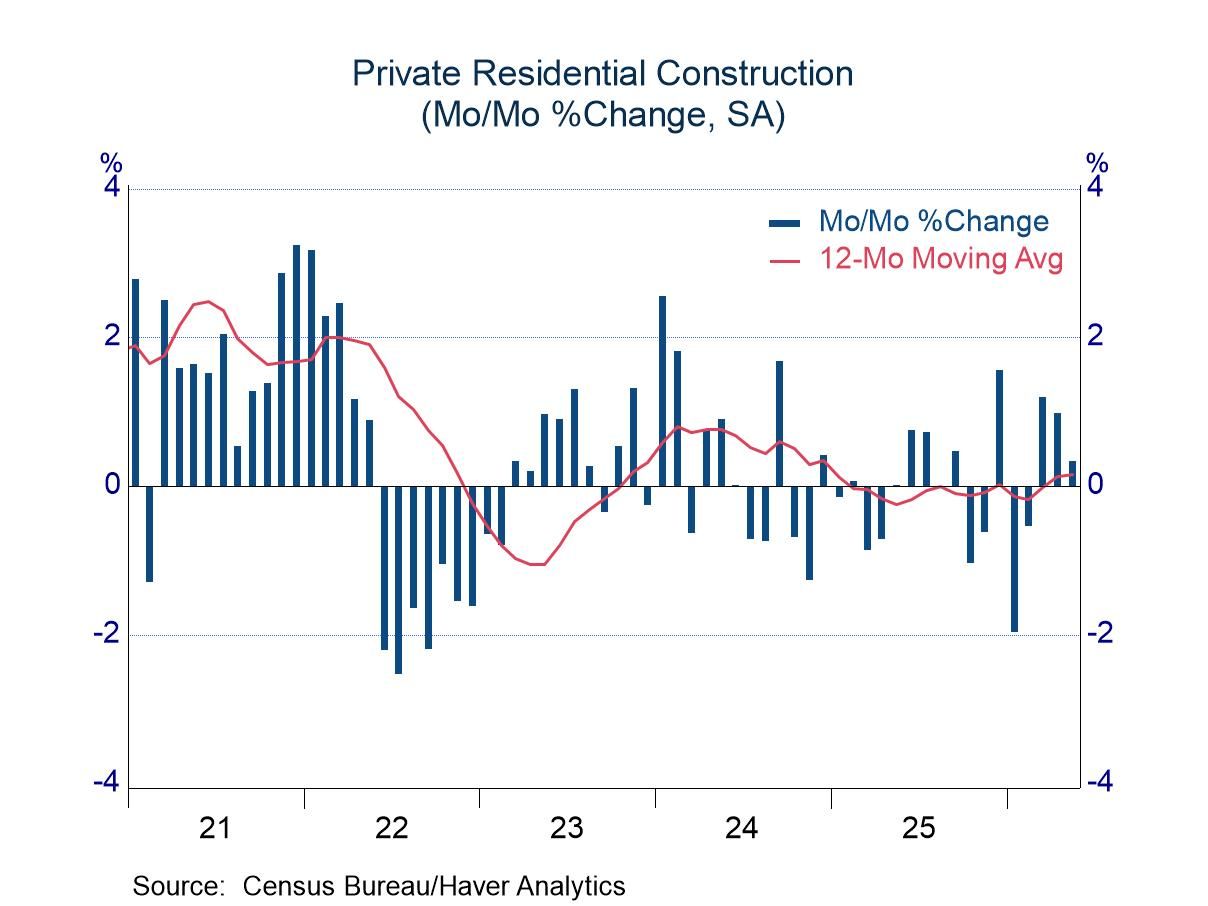
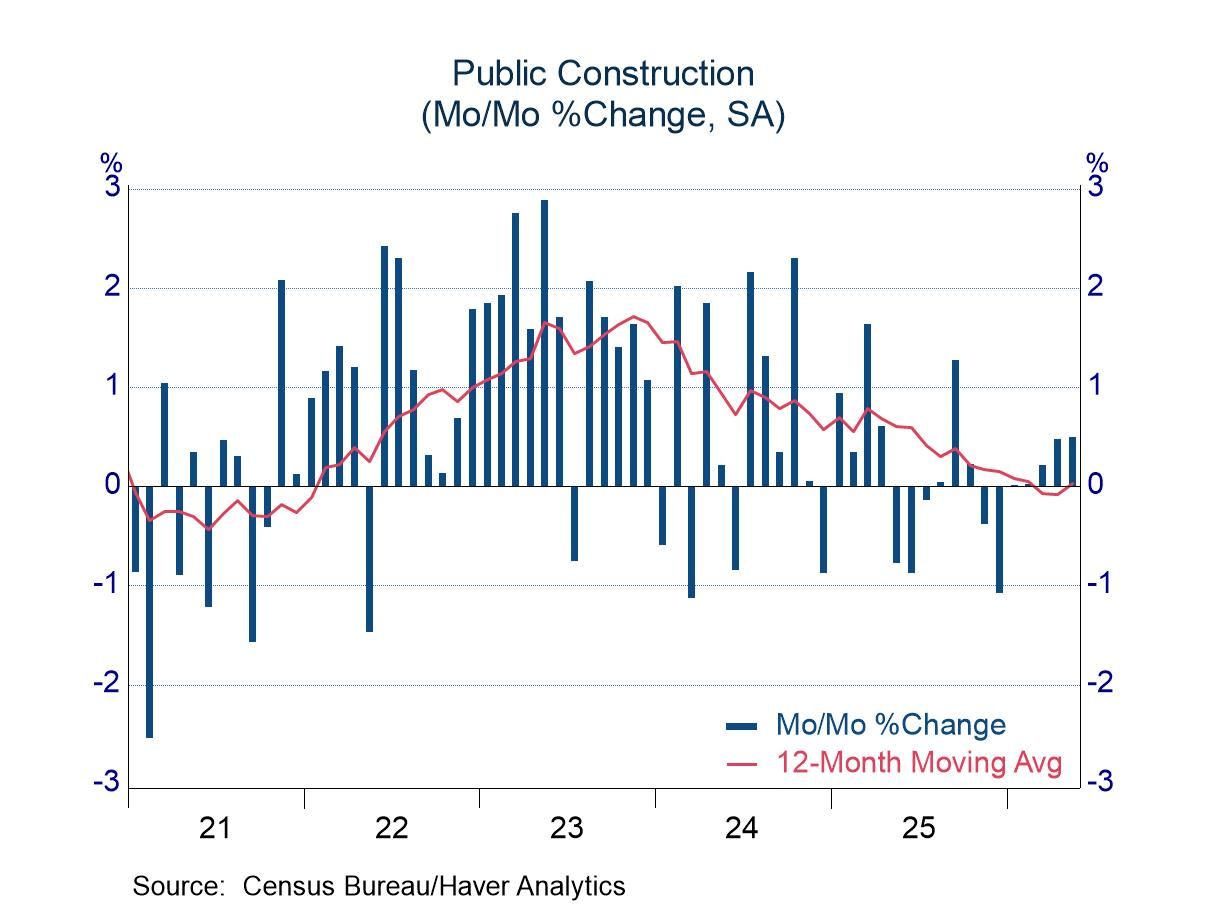
Private residential construction, the largest component of the total (41% share), rose 0.3% in May, adding to an average gain of 1.1% in the prior two months and leaving a year-over-year increase of 1.8% (chart, upper left). Most of the advance in the past year was the result of improvements to existing homes (up 8.1%). Construction of new multi-family units has shown little net change in the past year or so, while new single-family building has traced a mild downward trend (off 4.0% in the past year). Public construction has been flat in the past year, with both the federal government and state and local governments showing little net change (chart, upper right).
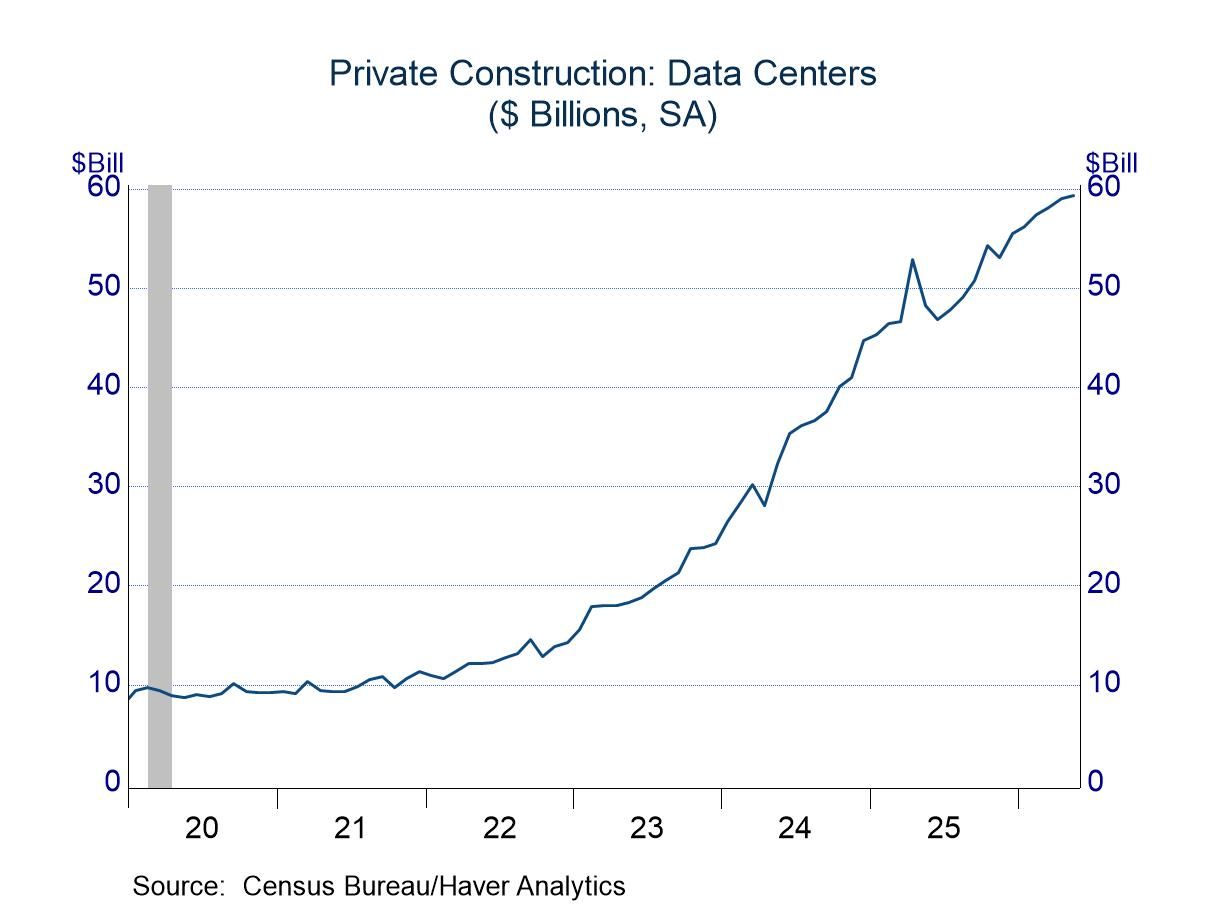
Private nonresidential construction (34% of the total) has received considerable press attention in the past few years because of explosive growth in the building of data centers. Growth has indeed been vigorous. Building started in 2020 and grew moderately at first, but this sector took off in 2022, about the time when artificial intelligence models became publicly available (chart, lower left, in levels to show the strong trend more clearly). Average annual growth for the three years ended 2025 totaled 48%.
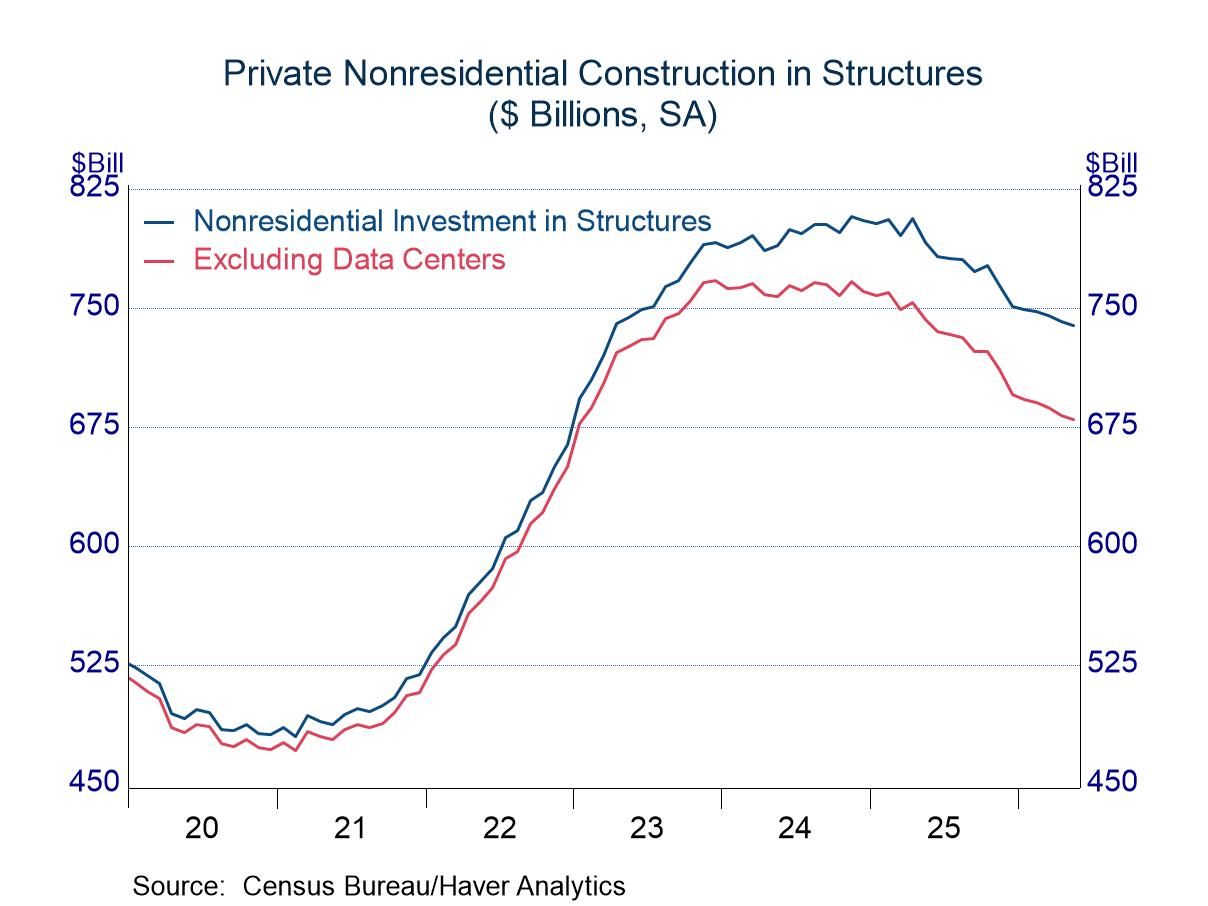
Interestingly, despite the rapid growth in the building of data centers, the private nonresidential sector has been the weakest area of the construction report, with activity trending lower since early 2025 (chart, lower right). Some components of private nonresidential construction have held steady or improved (e.g. amusement & recreation, electric power), but three areas stand out on the soft side: general office, commercial, and manufacturing.
The construction figures can be found in Haver's USECON database. The expectations figure is from the Action Economics Forecast Survey in AS1REPNA.

Michael J. Moran
AuthorMore in Author Profile »Before joining Haver Analytics in 2025, Michael J. Moran was the chief economist of Daiwa Capital Markets America Inc. He was responsible for preparing the firm’s economic forecast and interest rate outlook. He traveled frequently to visit the clients of Daiwa Capital Markets and wrote weekly economic commentary. Mr. Moran also was involved in the flux of financial markets, as he spent a portion of each day on Daiwa’s trading floor interpreting economic statistics and Federal Reserve activity for traders and salespeople. Mr. Moran is quoted frequently in the financial press, and he appears regularly on cable news shows. He also has published articles in several journals and periodicals. Before joining Daiwa Capital Markets America, Mr. Moran worked as an economist at the Federal Reserve Board in Washington, D.C. where he analyzed a broad range of issues dealing with the financial sector of the economy and regularly briefed the Board of Governors. He was on the faculty of Pennsylvania State University from 1979 to 1980 and taught on a part-time basis at George Washington University from 1980 to 1987.
Mr. Moran received his Ph.D. in economics from Pennsylvania State University in 1980 and a B.S. in business administration from the University of Bridgeport in 1975. He was a CFA charter holder from 2002 until 2016.
More Economy in Brief
 Global