Chicago Fed National Activity Index: Suggesting Trend-Like Growth
Summary
- January results showed noticeable improvement from prior months.
- All four components contribute positively.
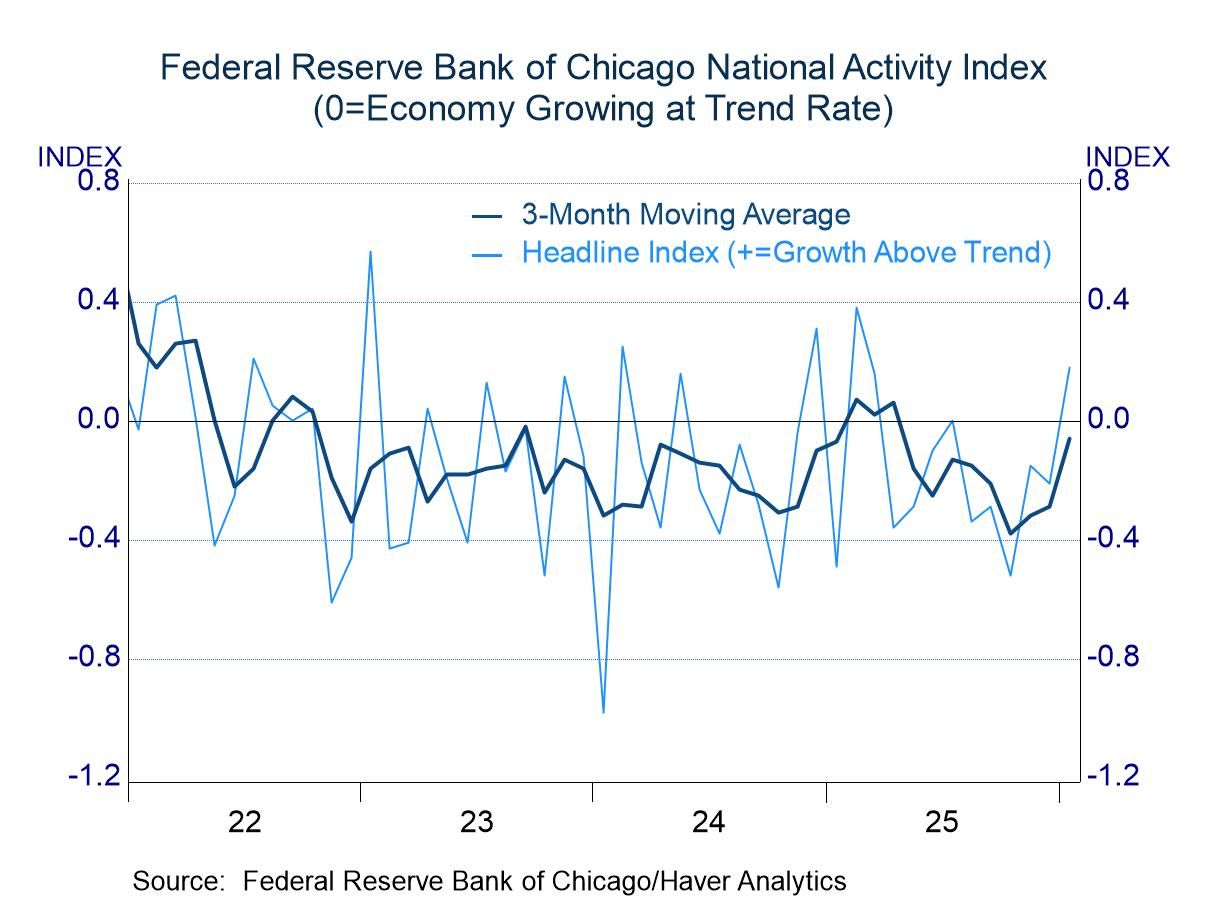
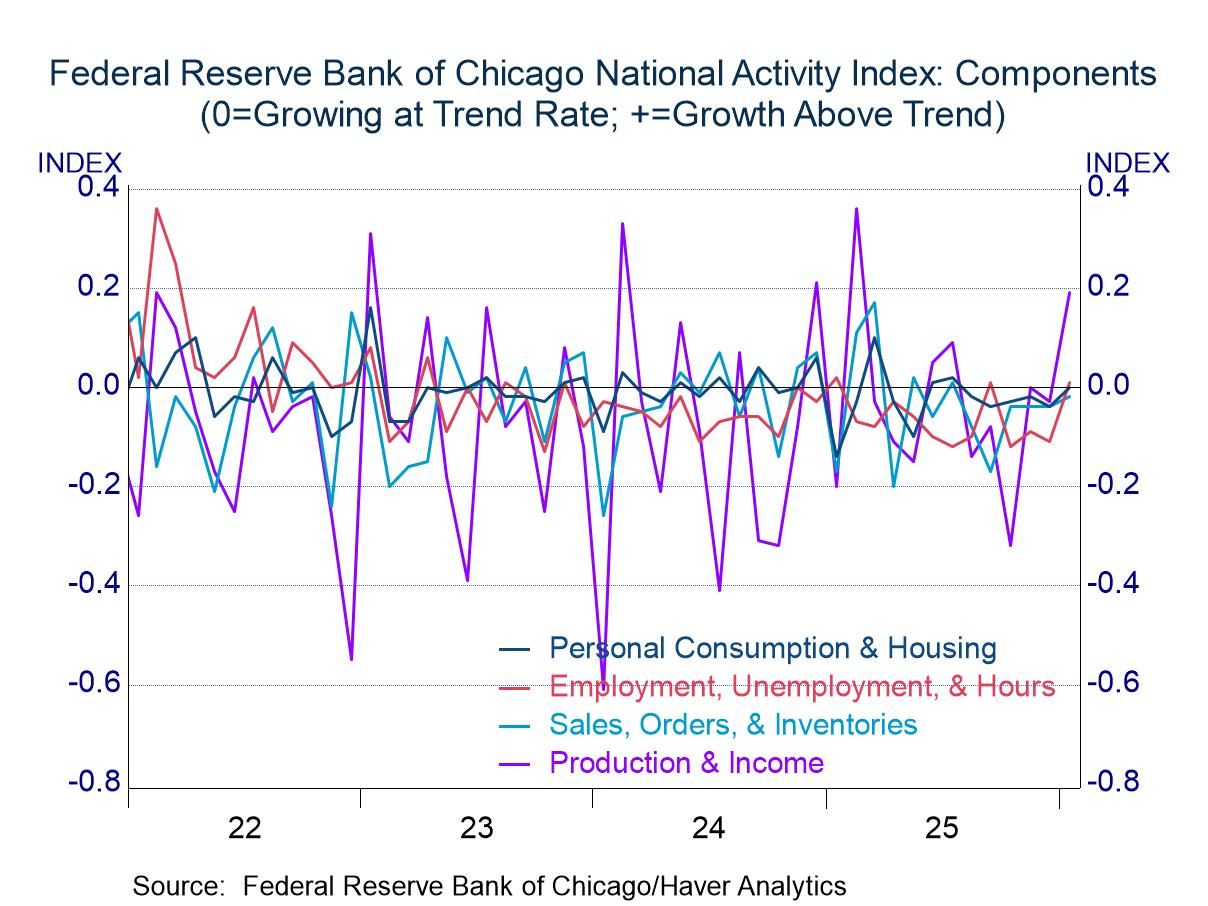
The National Activity Index published by the Federal Reserve Bank of Chicago totaled 0.18 in January, a jump of .39 index points from the reading in December. The latest tally was favorable. Not only did the measure post a sharp month-to-month change, but it also signaled that the economy is growing faster than its long-run trend rate.
(The index is constructed to equal zero when the economy is growing at its long-run trend rate. Thus, positive readings suggest brisk growth. Negative readings should not necessarily be viewed as disappointing. Researchers at the Chicago Fed note that the index needs to ease to -0.7 before recession becomes a risk. The measure would be deeper in negative territory if the economy was contracting.)
Although January brought encouraging news, an element of caution is warranted. The index often moves erratically, and thus a single monthly change could be dominated by random volatility. A three-month moving average squeezes out most of the volatility, leaving a more reliable perspective on the economy. Here, too, the news in January was favorable, as the 3-month average rose .23 index points to -.06, just a shade below a signal of trend growth and the best reading since April of last year. The eight months between April 2025 and January showed an average index value of -.24, with observations ranging from -.13 to -.38.
The National Activity Index is a composite of 85 economic indicators, grouped into four major categories: production and income; employment, unemployment, and hours worked; personal consumption and housing; sales, orders, and inventories. All four components improved month-to-month, with the production and income component providing most of the lift (up .22 index points to .19). Three of the four components were above zero in January, with only the sales, orders, and inventory in negative territory (and barely so at -0.02).
These figures are available in Haver's SURVEYS database.

Michael J. Moran
AuthorMore in Author Profile »Before joining Haver Analytics in 2025, Michael J. Moran was the chief economist of Daiwa Capital Markets America Inc. He was responsible for preparing the firm’s economic forecast and interest rate outlook. He traveled frequently to visit the clients of Daiwa Capital Markets and wrote weekly economic commentary. Mr. Moran also was involved in the flux of financial markets, as he spent a portion of each day on Daiwa’s trading floor interpreting economic statistics and Federal Reserve activity for traders and salespeople. Mr. Moran is quoted frequently in the financial press, and he appears regularly on cable news shows. He also has published articles in several journals and periodicals. Before joining Daiwa Capital Markets America, Mr. Moran worked as an economist at the Federal Reserve Board in Washington, D.C. where he analyzed a broad range of issues dealing with the financial sector of the economy and regularly briefed the Board of Governors. He was on the faculty of Pennsylvania State University from 1979 to 1980 and taught on a part-time basis at George Washington University from 1980 to 1987.
Mr. Moran received his Ph.D. in economics from Pennsylvania State University in 1980 and a B.S. in business administration from the University of Bridgeport in 1975. He was a CFA charter holder from 2002 until 2016.
More Economy in Brief
 Global