Chicago Fed National Activity Index Slipped in March
by:Sandy Batten
|in:Economy in Brief
Summary
- The monthly reading fell to -0.20 in March from an upwardly revised +0.03 in February.
- The three-month average slipped from +0.03 to -0.03.
- Despite the slip in March, the index points to near-trend economic growth and is well above recession territory.
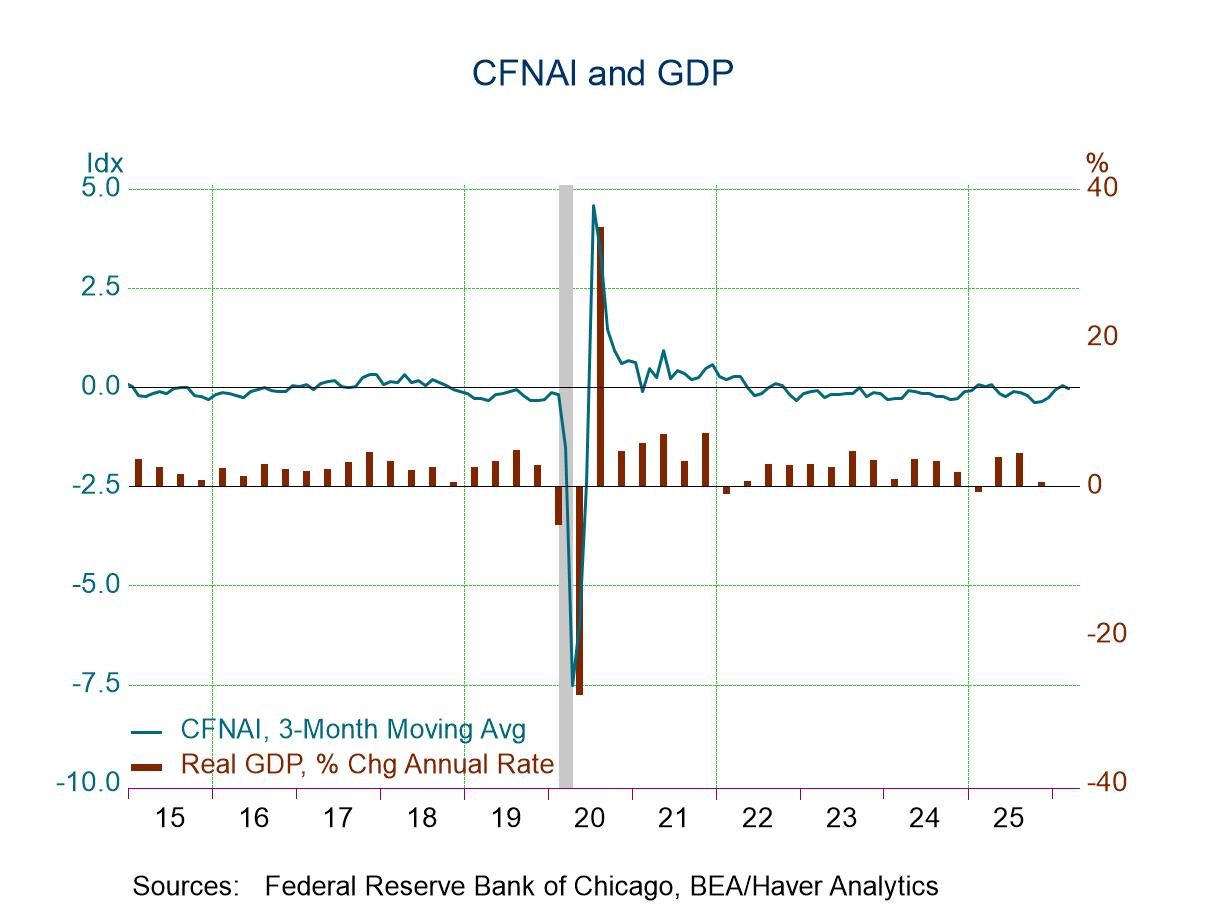
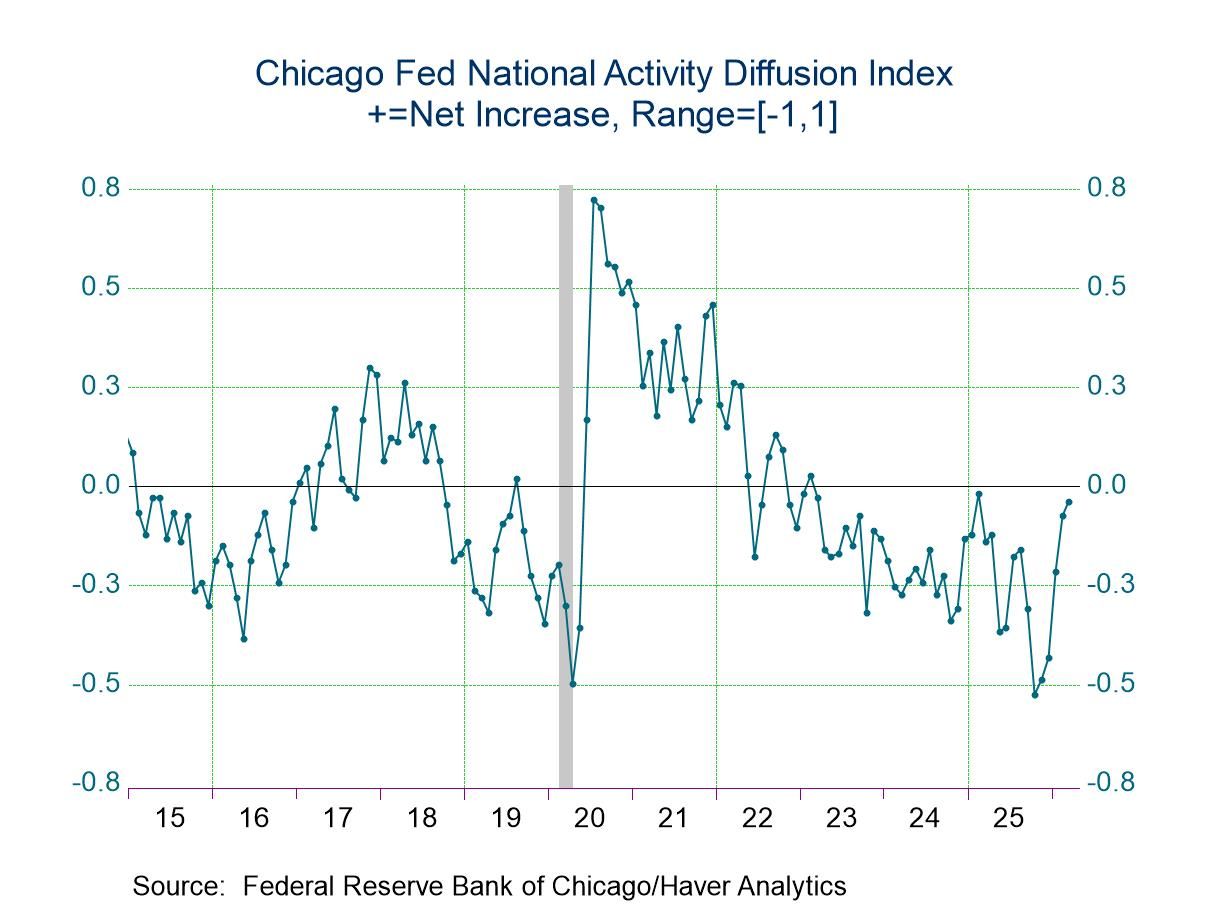
The National Activity Index published by the Federal Reserve Bank of Chicago (CFNAI) slipped to -0.20 in March from an upwardly revised +0.03 in February (previously (-0.11). This is the lowest monthly reading since last November. Smoothing out the monthly volatility, the index's three-month moving average (CFNAI-MA3) declined to -0.03 in March from an upwardly revised +0.03 in February (previously -0.01).
This index is expressed in standard deviation units from zero (with a value of zero defined as trend real GDP growth). Research at the FRB Chicago indicates that readings on the 3-month average of -0.70 or below are consistent with the economy being in a recession. Therefore, even though the March reading on the 3-month average was negative, it indicates that the US economy is still growing, just slightly slower than trend, and is well away from recessionary conditions. The 3-month average would be much deeper in negative territory if the economy was at risk of contracting.
The National Activity Index is a composite of 85 economic indicators, grouped into four major categories: production and income; employment, unemployment, and hours worked; personal consumption and housing; sales, orders, and inventories. Three of the four broad categories of indicators used to construct the index decreased from February, and three categories made negative contributions in March. Production-related indicators contributed –0.20 to the CFNAI in March, down from +0.13 in February. The sales, orders, and inventories category's contribution to the CFNAI was –0.01 in March, down from +0.05 in February. Employment-related indicators contributed +0.02 to the CFNAI in March, up from –0.15 in February. The personal consumption and housing category's contribution to the CFNAI was –0.01 in March, down from a neutral value in February.
The CFNAI Diffusion Index, which measures the breadth of the change in the component series and is also a three-month moving average, increased to –0.04 in March from –0.08 in February. This is the highest reading since February 2025. A reading of zero indicates that all of the indicators are growing at their long-term average. If all of the underlying indicators in a given month are below their long-run averages, the diffusion index will equal -1. If all of the indicators are above their long-run averages, it will equal +1. Thirty-four of the 85 individual indicators made positive contributions to the CFNAI in March, while 51 made negative contributions. Forty-three indicators improved from February to March, while 40 indicators deteriorated and two were unchanged. Of the indicators that improved, 16 made negative contributions.
These figures are available in Haver's SURVEYS database.

Sandy Batten
AuthorMore in Author Profile »Sandy Batten has more than 30 years of experience analyzing industrial economies and financial markets and a wide range of experience across the financial services sector, government, and academia. Before joining Haver Analytics, Sandy was a Vice President and Senior Economist at Citibank; Senior Credit Market Analyst at CDC Investment Management, Managing Director at Bear Stearns, and Executive Director at JPMorgan. In 2008, Sandy was named the most accurate US forecaster by the National Association for Business Economics. He is a member of the New York Forecasters Club, NABE, and the American Economic Association. Prior to his time in the financial services sector, Sandy was a Research Officer at the Federal Reserve Bank of St. Louis, Senior Staff Economist on the President’s Council of Economic Advisors, Deputy Assistant Secretary for Economic Policy at the US Treasury, and Economist at the International Monetary Fund. Sandy has taught economics at St. Louis University, Denison University, and Muskingun College. He has published numerous peer-reviewed articles in a wide range of academic publications. He has a B.A. in economics from the University of Richmond and a M.A. and Ph.D. in economics from The Ohio State University.
More Economy in Brief
 Global