Belgian Consumer Confidence Clings to a Positive Reading
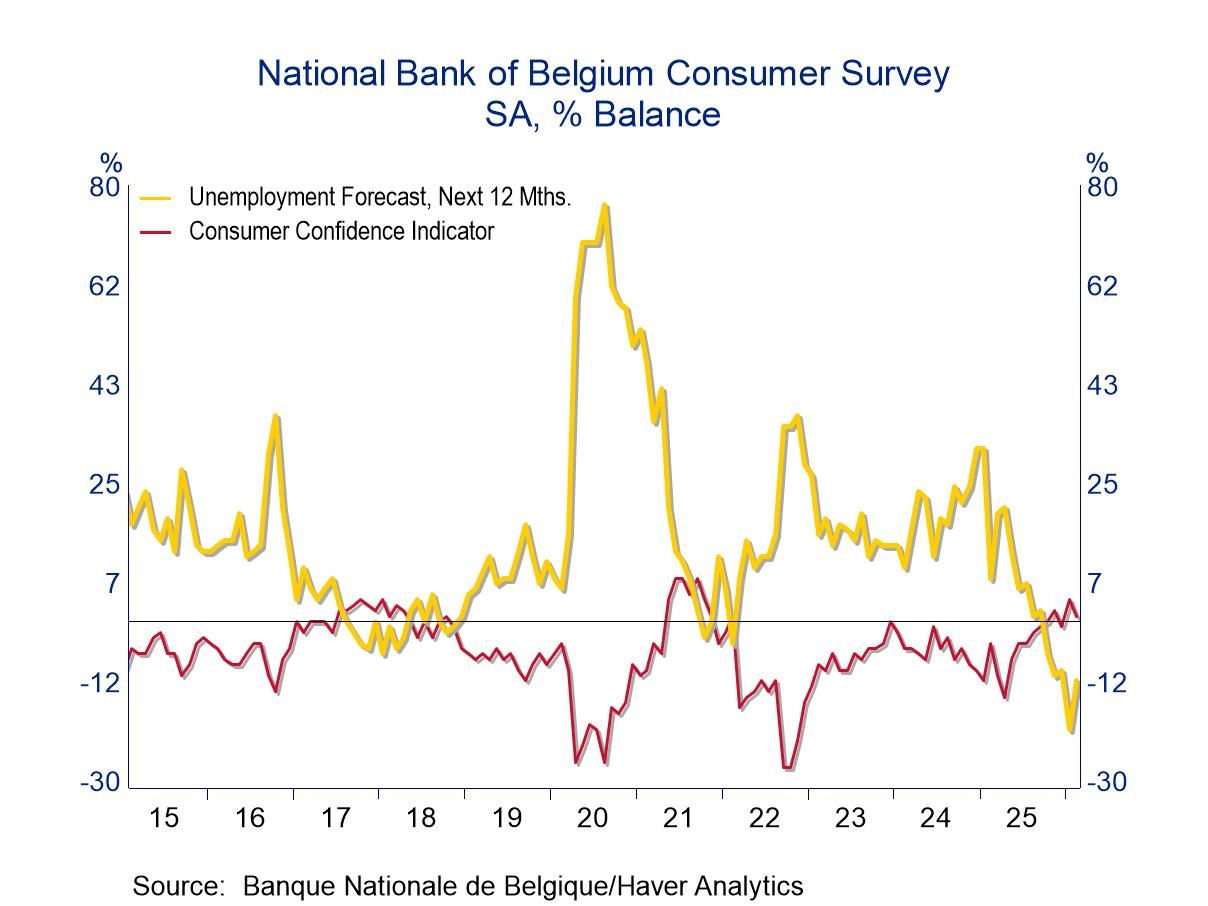
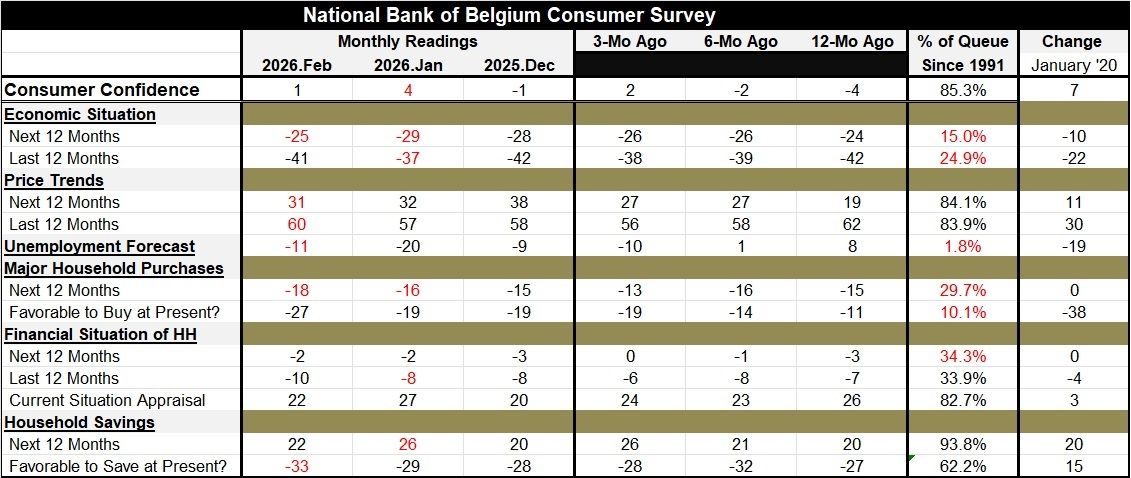
Belgian consumer confidence slipped in February. But it has made a long climb back to positive territory and that reading is holding on at +1 in February, down from +4 in January.
Belgian consumer confidence has been slowing progressing from a reading of -4 twelve-months ago to -2 six-months ago and to +2 just three-months ago. This progression shows a trend of improvement under way for the Belgian consumer.
Also, importantly, the queue reading of the consumer index in February is at a standing of 85.3, a top 15-percentile reading on data since 1991.
The economic situation is not as robust. It has improved for the next 12 months to -25 from a reading of -29 in January. There is a slight weakening in readings from 12-months to 6-months to 3-months, and the current February reading of -25 diffusion has a 15-percentile standing on data back to 1991. This concept carries a larger negative value over the next 12 months than under the last 12 months. However, that reading nonetheless has a stronger standing at its 24.9 percentile than the outlook for the 12 months ahead. The economic situation is clearly suppressed compared to the confidence reading.
Prices show a slight weakening for the next 12 months compared to the January reading. However, the 12-month to 6-month to 3-month readings show a move up to stronger price levels. The ranking of the February price reading is a top 16-percentile reading; inflation in Belgium is still on the hot side.
However, prospects for unemployment have shifted sharply to show a much lower expectation of unemployment; unemployment expectations increased from -20 in January to a diffusion reading of -11 in February, with a ranking in its lower two percentile.
The environment for making a major household purchase over the next 12 months has eroded over the past few months, although it shows a trend toward improvement from 12-months to 6-months to 3-months. Still, the February reading has a 29.7 percentile standing, well below its historical median (represented by a 50 percentile standing).
The ‘favorable to spend at present’ index weakened quite sharply in February and has been slipping from 12-months to 6-months to 3-months. It registered in February a standing in only its 10th percentile, extremely weak. The consumer is not leading Belgium into recovery on the back of spending.
The financial situation expected over the next 12 months has been relatively static month-to-month as well as across the last 12 months. The ranking for expected conditions is weak at a 34th percentile reading. But the current financial situation, while stepping back on the month, has an 82.7 percentile standing. The financial situation reading appears to be in some flux, but the actual current readings have been firm in relatively strong territory for some time.
Household savings for the next 12 months backed down in February but had been strengthening over the past year. The February reading is quite high, a top 9-percentile reading. The favorability to save has not changed much over the past year but has eroded slightly in February. The February current assessment for savings is at a 62.2 percentile reading, much weaker than its 12-month outlook reading.
The Belgian consumer is experiencing some crosscurrents. Consumer readings are underpinned by low expectations for unemployment and by a solid current situation appraisal. However, the economic situation remains weak and is not trending higher and inflation readings are still uncomfortably high.

Robert Brusca
AuthorMore in Author Profile »Robert A. Brusca is Chief Economist of Fact and Opinion Economics, a consulting firm he founded in Manhattan. He has been an economist on Wall Street for over 25 years. He has visited central banking and large institutional clients in over 30 countries in his career as an economist. Mr. Brusca was a Divisional Research Chief at the Federal Reserve Bank of NY (Chief of the International Financial markets Division), a Fed Watcher at Irving Trust and Chief Economist at Nikko Securities International. He is widely quoted and appears in various media. Mr. Brusca holds an MA and Ph.D. in economics from Michigan State University and a BA in Economics from the University of Michigan. His research pursues his strong interests in non aligned policy economics as well as international economics. FAO Economics’ research targets investors to assist them in making better investment decisions in stocks, bonds and in a variety of international assets. The company does not manage money and has no conflicts in giving economic advice.
More Economy in Brief
 Global