A Counterpoint to the ECB Rate Hike from German Core Inflation

On the day that the European Central Bank met and decided to raise interest rates by 25 basis points, the German inflation report for August firmed, showing that headline inflation rose 0.3% on the month, with the core rising by 0.1%. Year-over-year headline inflation in Germany is excessive at 3%. However, the core rate at only 2.3% is not that far above the ECB target for all of the monetary union, a pace of 2%. German inflation for the headline is 3.6% over six months and 3.7% over three months; however, over three months and six months, German core inflation is running at 2%, the ECB’s chosen speed for inflation for the union as a whole.
German core inflation provides a counterpoint to headline inflation. It enables a strong argument that energy price inflation has not spread throughout the monetary union. However, with the ECB raising rates, German bond yields have risen to a 17-year high and the ECB seems determined to treat energy price inflation as something important and significant that it needs to fend off.
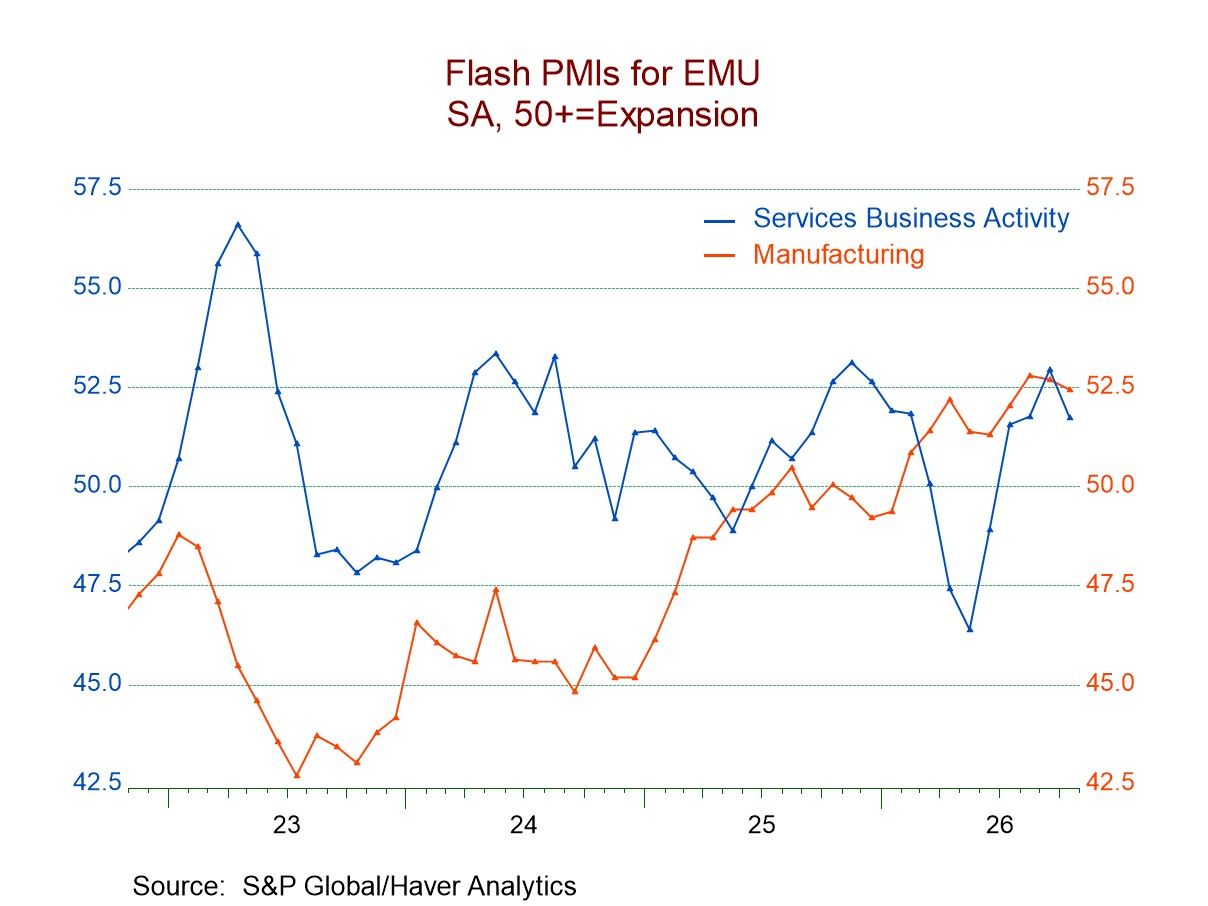
Economic conditions still show growth in the monetary union as weak at 1.0%. Growth among the top four economies is 1.1% with growth for the rest of the union year-over-year at 0.5%. So, the ECB is raising interest rates in an environment where growth is modest-to-low and where headline inflation is surging but where core inflation is much better behaved. The pace for Germany at 2% over three months and six months is right on target; 2.3% over 12 months is slightly excessive. For the entire euro area, the core inflation rate is closer to 2.5%, which is uncomfortable but not a terrible overshoot, certainly not with energy prices having flared the way they have.
Diffusion statistics show that inflation over three months in Germany has accelerated in only 27.3% of the categories; however, inflation has accelerated in 72.7% of the categories over six months and in 63.6% of the categories over 12 months. The tempered three-month inflation rate breadth does not dominate the other two metrics; however, it provides another counterpoint to the notion that inflation from oil price increases is spreading.

Globally, oil prices are spiking again today. At the ECB press conference, the staff outlook shows inflation remaining high and stubborn for the monetary union as a whole over the next year, and this likely is a reason for the ECB to have raised rates and possibly to be ready to raise rates again. Commentary is beginning to reset probabilities for another rate hike at a higher probability before the end of the year. Of course, a lot of that is going to depend on how oil prices evolve and on growth. In the meantime, higher interest rates are going to make fiscal policy more of a problem in the EMU. Many European member countries already have high debt-to-GDP ratios, and the inability to put a cork in the bottle holding oil prices in the Strait of Hormuz is creating clear policy problems for the global economy.

Robert Brusca
AuthorMore in Author Profile »Robert A. Brusca is Chief Economist of Fact and Opinion Economics, a consulting firm he founded in Manhattan. He has been an economist on Wall Street for over 25 years. He has visited central banking and large institutional clients in over 30 countries in his career as an economist. Mr. Brusca was a Divisional Research Chief at the Federal Reserve Bank of NY (Chief of the International Financial markets Division), a Fed Watcher at Irving Trust and Chief Economist at Nikko Securities International. He is widely quoted and appears in various media. Mr. Brusca holds an MA and Ph.D. in economics from Michigan State University and a BA in Economics from the University of Michigan. His research pursues his strong interests in non aligned policy economics as well as international economics. FAO Economics’ research targets investors to assist them in making better investment decisions in stocks, bonds and in a variety of international assets. The company does not manage money and has no conflicts in giving economic advice.
More Economy in Brief
 Asia
Asia