Haver Analytics
Haver Analytics

Featured Data Additions: June 2026

  • EMERGEPRSouth Korea → Financial → Money, Banking and Credit → Substandard or Below Loans

    Substandard or below (SBL) bank loan detail for South Korea was added to the EMERGEPR database. SBL totals, resolved SBL, and SBL ratios by sector are available on this table. Quarterly data are sourced from the Financial Supervisory Service and begin in Q1 2008.

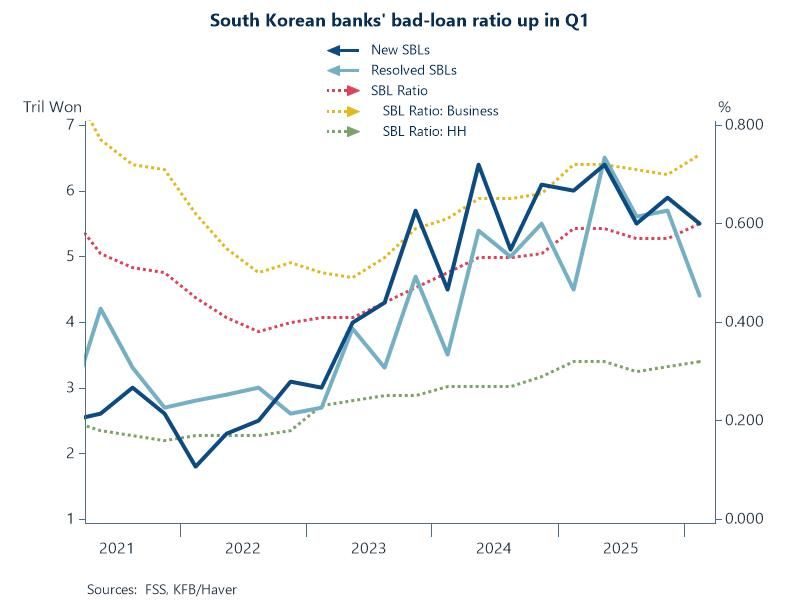
    Chart: SBLs in Korea recorded their highest levels since Q2 2019. Some 5.5 tril won in loans were newly classified as soured in Q1, down 400 bil from Q4. Banks wrote off 4.4 tril worth of bad loans, down 1.3 tril. Business loan SBL ratios registered 0.74%, up 0.04 ppt. HH loan SBL ratio came in at 0.32%, also up 0.01 ppt. Despite an increase in absolute terms, the overall SBL ratio remains relatively stable at 0.6%, safely kept in check by bank write-offs and aggressive settlements.

  • UKRBermuda → National Accounts → GDP by Expenditure

    GDP by expenditure for Bermuda was added to UKR, as we continue to add content for this British Overseas Territory in the North Atlantic. Some detail for consumption, gross capital formation and foreign trade is available in current and constant dollars. Quarterly data are sourced from the Government of Bermuda and start in Q1 2014.

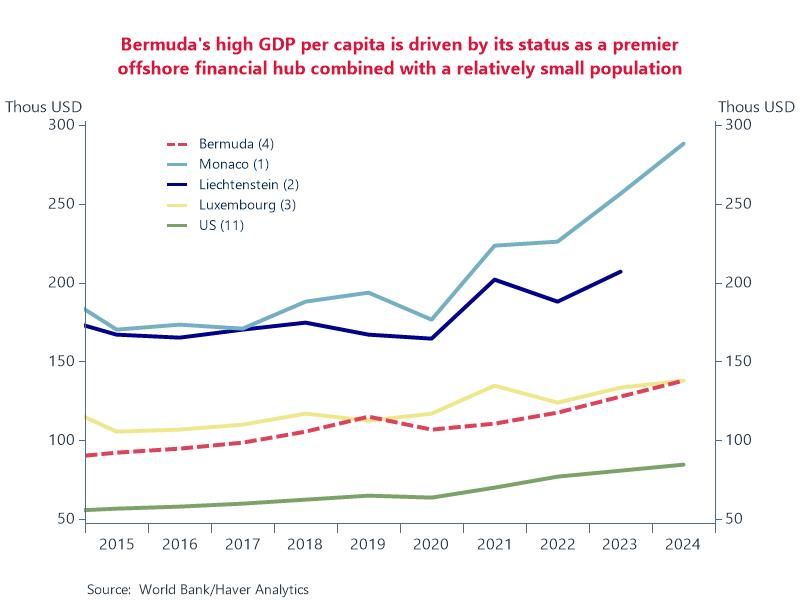
    Chart: Of interest regarding Bermuda’s GDP is its claim to one of the highest GDP per capita metrics in the world – currently registering at over $137k per resident. Only Monaco, Liechtenstein and Luxembourg can boast higher. Bermuda's exceptionally high rank is driven by its status as a premier offshore financial hub - and because it has virtually no corporate or personal income tax, it attracts thousands of international companies that generate enormous economic output on paper combined with a relatively small population of ~64,000.

  • EMERGEPRSouth Korea → Financial → Money, Banking and Credit → Delinquency Rates on Bank Loans

    Delinquency rates on bank loans for South Korea were added to EMERGEPR. More than 1-day and more than 30-day rates for enterprises, households and credit cards are available for commercial and specialized banks. Monthly and annual data are sourced from the Korea Federation of Banks and start as early as 1998.

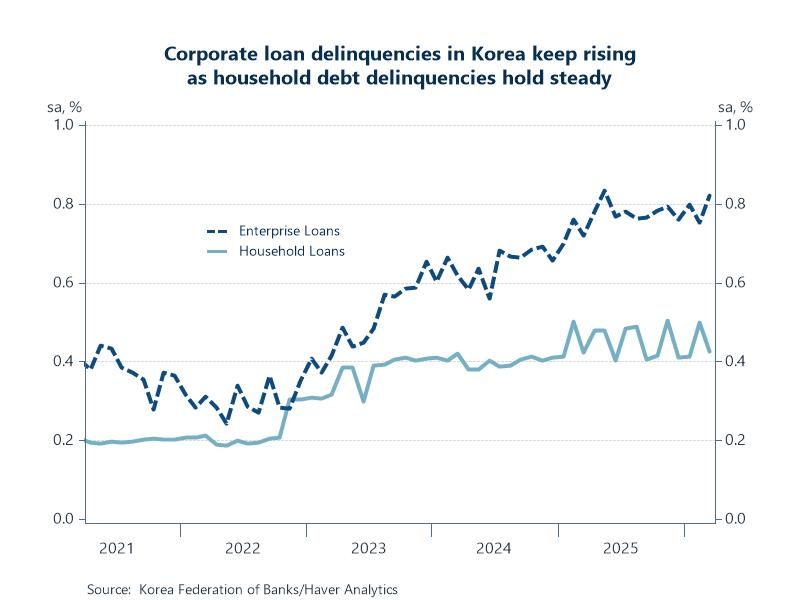
    Chart: Corporate loan delinquency rates in South Korea are rising faster than household delinquencies. Corporate delinquency rates reached 0.8% at the end of March compared to 0.4% for households – a spread that has been widening since mid-2023. Despite worsening economic conditions, financial authorities have been pressuring banks to expand corporate lending to stimulate business investment. Conversely, strict loan restrictions and debt service ratio rules on household mortgages have been keeping household delinquencies more stable.

  • USECON → Business Cycle Indicators and Surveys → Supply Chain Bottleneck Sentiment

    The Supply Chain Bottleneck (SCB) Sentiment index was added to USECON. This index utilizes unsupervised machine learning and natural language processing techniques to identify words related to supply chain bottlenecks in the Federal Reserve's Beige Book and uses deep learning to account for the sentiment of the identified supply chain text. Monthly data are sourced from the FRB and start in May 1970.

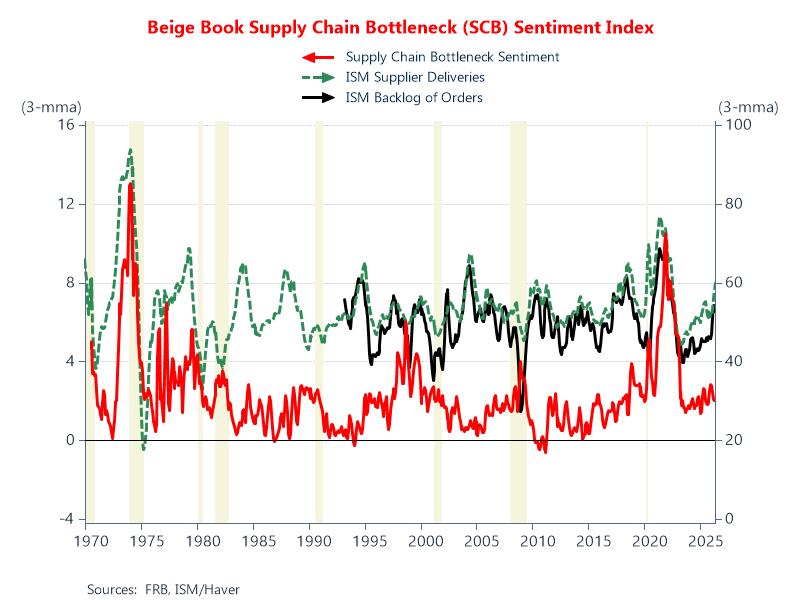
    Chart: Supply chains were stressed after the 1973 OPEC embargo and the 1979 increases in oil prices resulting from the Iranian Revolution. More recently, bottlenecks arose during the COVID-19 pandemic due to global factory slowdowns, shifts in consumer demand and severe labor shortages. The index suggests that the bottlenecks arising from the pandemic started declining in the latter half of 2021. This is in line with other measures of supply chain bottlenecks, such as the ISM supplier delivery times and order backlogs indexes.