

 Global| Jun 12 2026
Featured Data Additions, June 12, 2026
EMERGEPR → South Korea → Financial → Money, Banking and Credit → Delinquency Rates on Bank Loans
Delinquency rates on bank loans for South Korea were added to EMERGEPR. More than 1-day and more than 30-day rates for enterprises, households and credit cards are available for commercial and specialized banks. Monthly and annual data are sourced from the Korea Federation of Banks and start as early as 1998.
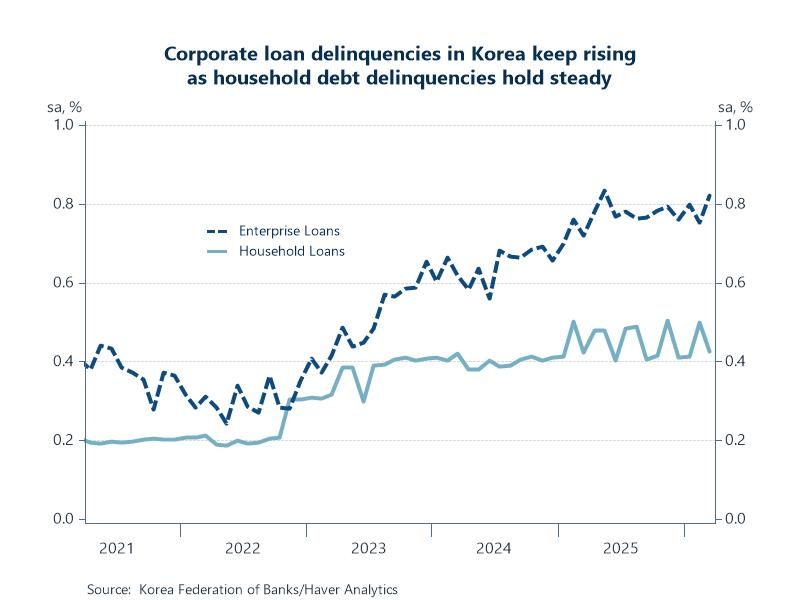
Chart: Corporate loan delinquency rates in South Korea are rising faster than household delinquencies. Corporate delinquency rates reached 0.8% at the end of March compared to 0.4% for households – a spread that has been widening since mid-2023. Despite worsening economic conditions, financial authorities have been pressuring banks to expand corporate lending to stimulate business investment. Conversely, strict loan restrictions and debt service ratio rules on household mortgages have been keeping household delinquencies more stable.
CMDTY → Spot Prices → Agricultural Prices → Brazil Agricultural Prices
Cattle, poultry and swine prices for Brazil were added to the CMDTY database. Various prices, depending on the commodity, are reported in US dollars for Sao Paolo, Mato Grosso do Sul, Minas Gerais, Parana, Rio Grande do Sul and Santa Catarina. Daily data are sourced from the Center for Advanced Studies on Applied Economics and start as early as 1994.
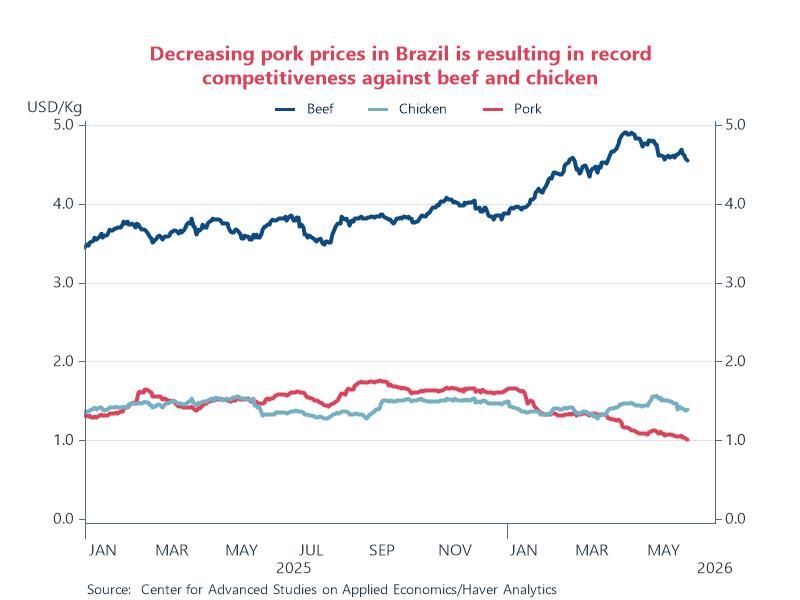
Chart: Brazil's meat market is characterized by production cycles, foreign and domestic demand. Beef prices recently hit record highs as the cattle cycle shifted into a rebuilding phase and thus limiting supply. Conversely, pork prices have been falling since early 2026 due to a surge in domestic supply in tandem with dampened domestic demand. Chicken prices have seen modest increases since March due to a solid export market mainly to China and the EU. Given these conditions, Brazilian pork is achieving record competitiveness against beef and chicken.
UK → Cyclical Indicators & Surveys → Decision Maker Panel (DMP) Survey → Energy Shock Adjustment
Responses to a new question in the DMP Survey regarding Iran war energy price shocks over the next year were added to the UK database. Answers relate to impacts on sales volumes, employment, prices, wages and profit margins. CFOs from >2,000 small, medium and large UK businesses are surveyed. Monthly data are sourced from the Bank of England and start in April 2026.
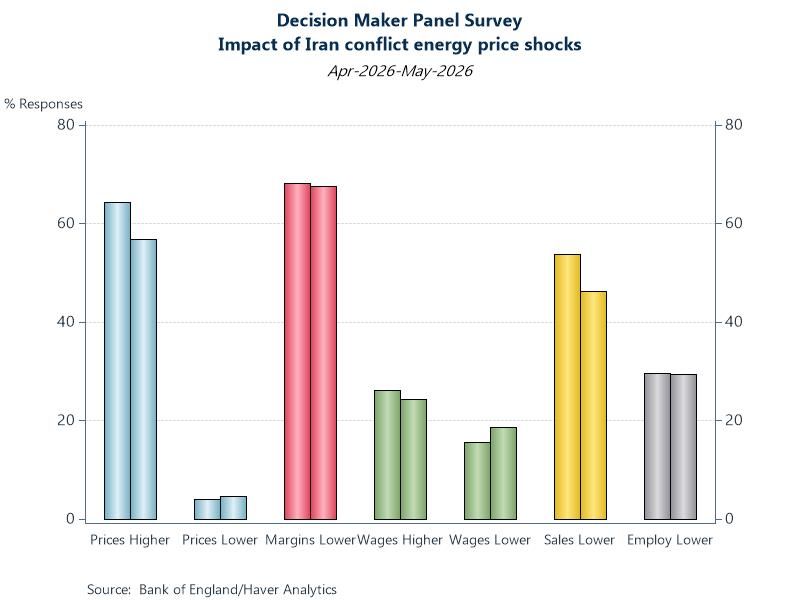
Chart: In May, higher prices and lower profit margins continue to be the most common forms of adjustment. 57% of firms expected to increase their prices (down 7 ppts) – only 5% expect to lower prices. 68% of firms expected their profit margins to be lower (unchanged). The picture was more mixed on wages, with 24% expecting wages to be higher (down 2 ppts) and 19% expecting them to be lower. Sales and employment are also expected to be lower than they would have been, on average.
More Featured Data Additions
 Global| Sep 23 2026
Featured Data Additions, September 23, 2026
 Global| Sep 18 2026
Featured Data Additions, September 18, 2026
 Global| Sep 02 2026
Featured Data Additions, September 2, 2026
 Global| Aug 27 2026