U.S. Factory Orders Exceed Expectations in March
Summary
- Factory orders +1.5% m/m (+2.1% y/y) in Mar.; 9.5% above the Jan. ’24 low.
- Durable goods orders +0.8%, first m/m increase since Nov.; nondurable goods orders +2.1%, largest of four straight m/m gains; shipments +1.4%, fourth successive m/m rise.
- Transportation orders +0.8%, driven by m/m surges of 30.9% in ships & boats and 17.8% in defense aircraft orders.
- Computers & electronic products +3.6%, fastest of seven consecutive m/m rises.
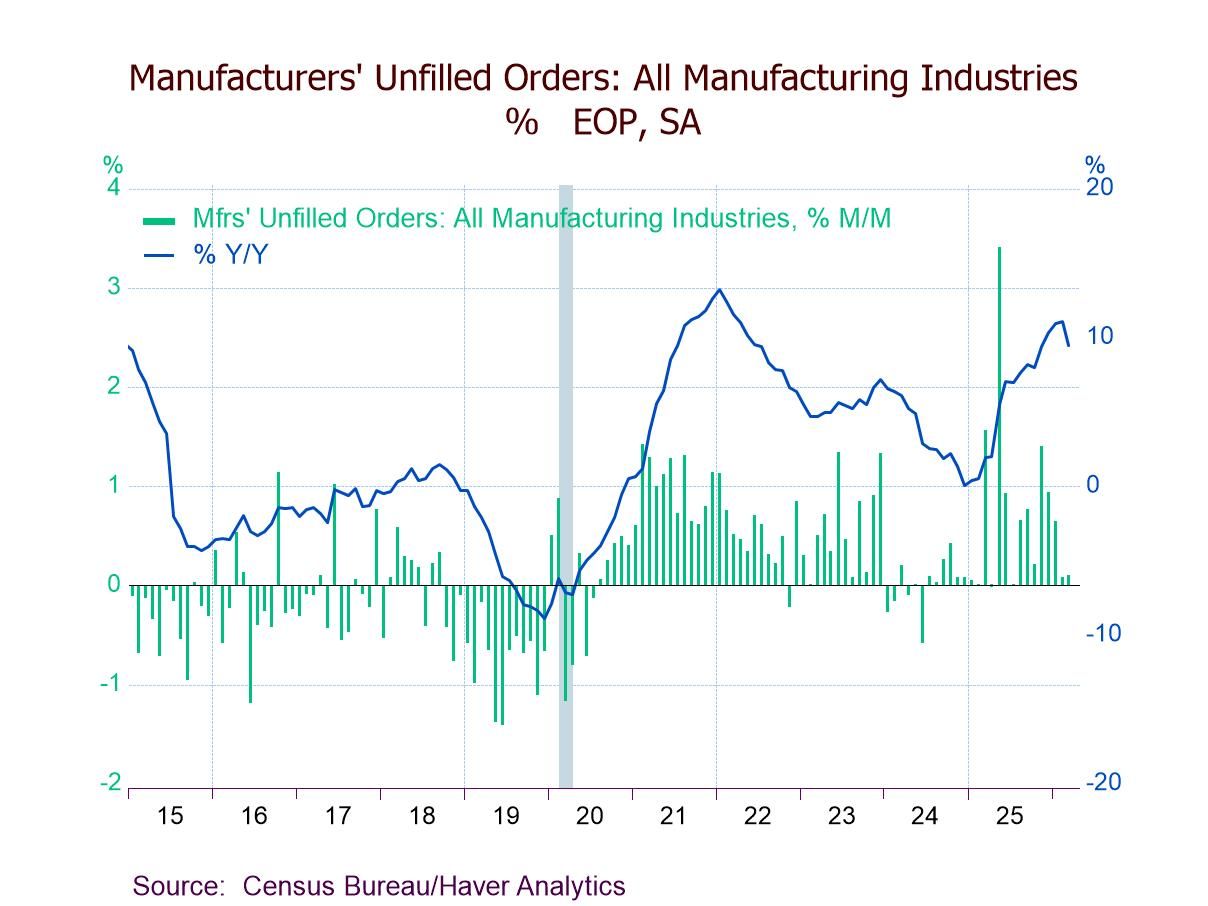
- Unfilled orders +0.1%, eighth straight m/m increase.
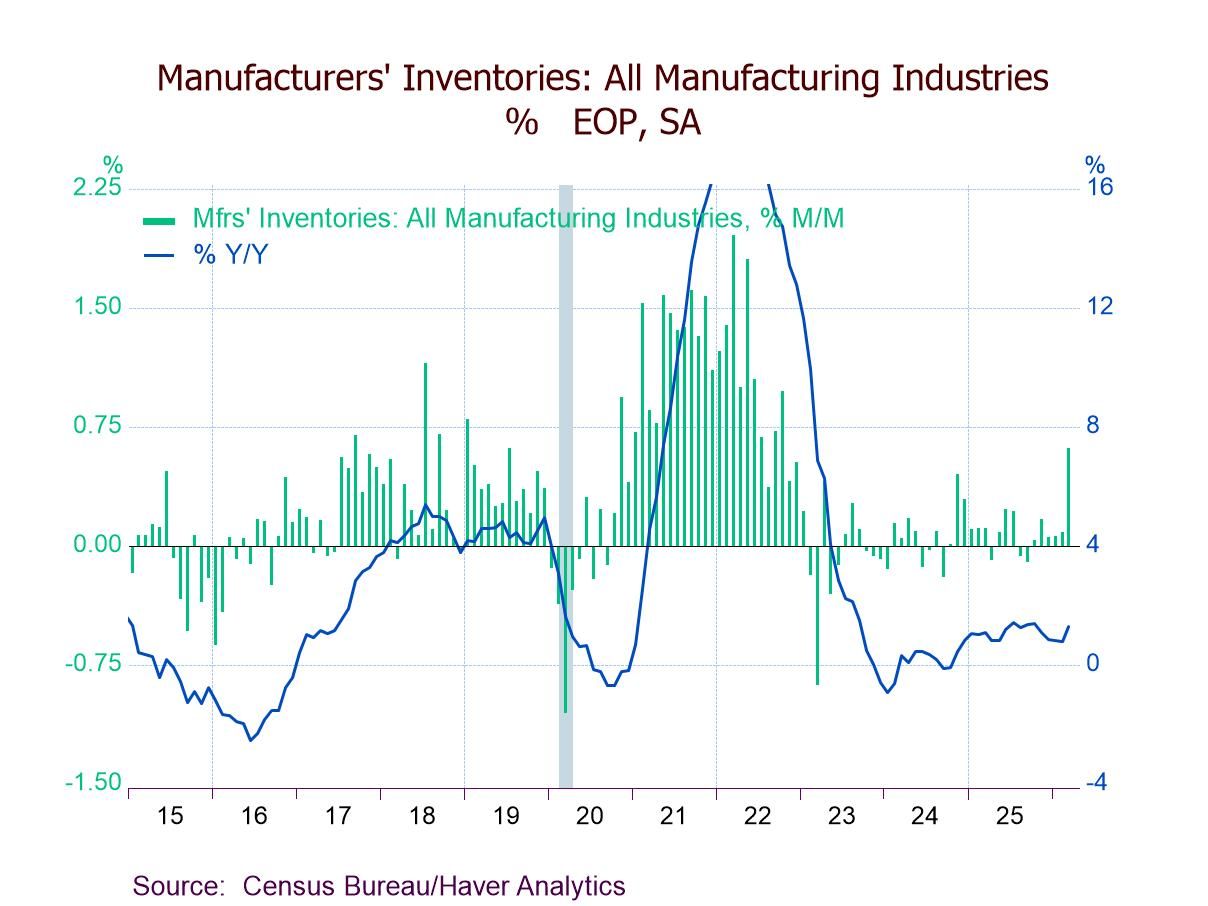
- Inventories +0.6%, biggest of five consecutive m/m gains.
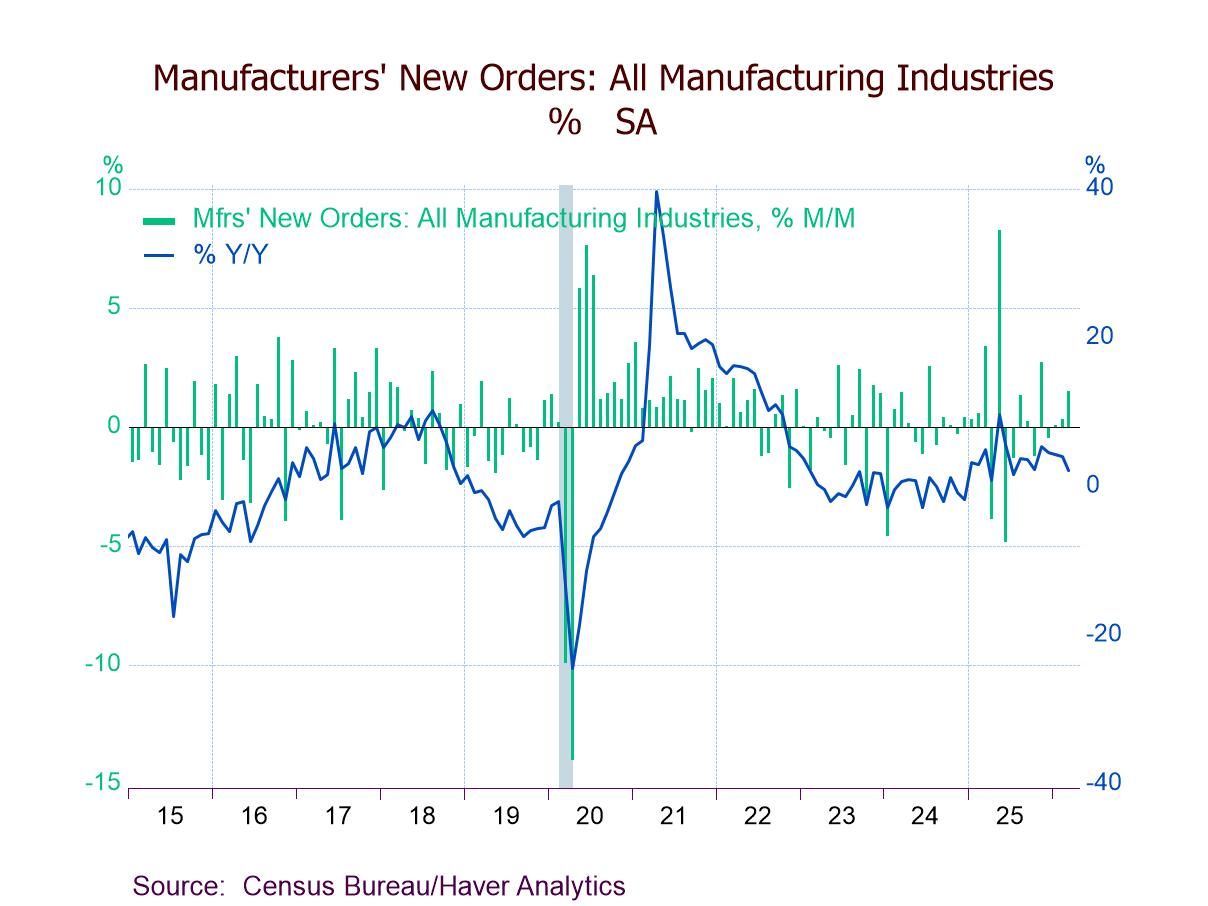
Total factory orders rose a stronger-than-expected 1.5% m/m in March following a 0.3% increase in February and a flat reading in January, according to data from the U.S. Census Bureau. The Action Economics Forecast Survey had expected a 0.5% m/m March increase. The year-on-year growth rate decelerated to 2.1% in March, the lowest since July 2025, from 4.0% in February (+4.9% in March 2025), remaining far below the April 2021 peak of 39.6%. Notably, orders for ships & boats surged 30.9% m/m in March after a 12.8% decrease in February and an 8.1% rise in January, and orders for defense aircraft & parts jumped 17.8% following a 0.6% February increase and a 26.9% January slump, while orders for nondefense aircraft & parts dropped 21.1% on top of a 33.3% February plunge and a 1.7% January decline. Factory orders excluding defense climbed 0.9% (0.8% y/y), the fourth m/m gain in five months, following a 0.3% February increase. Factory orders excluding the transportation sector rose 1.6% (5.1% y/y), the fifth straight m/m rise, after a 1.6% February gain.
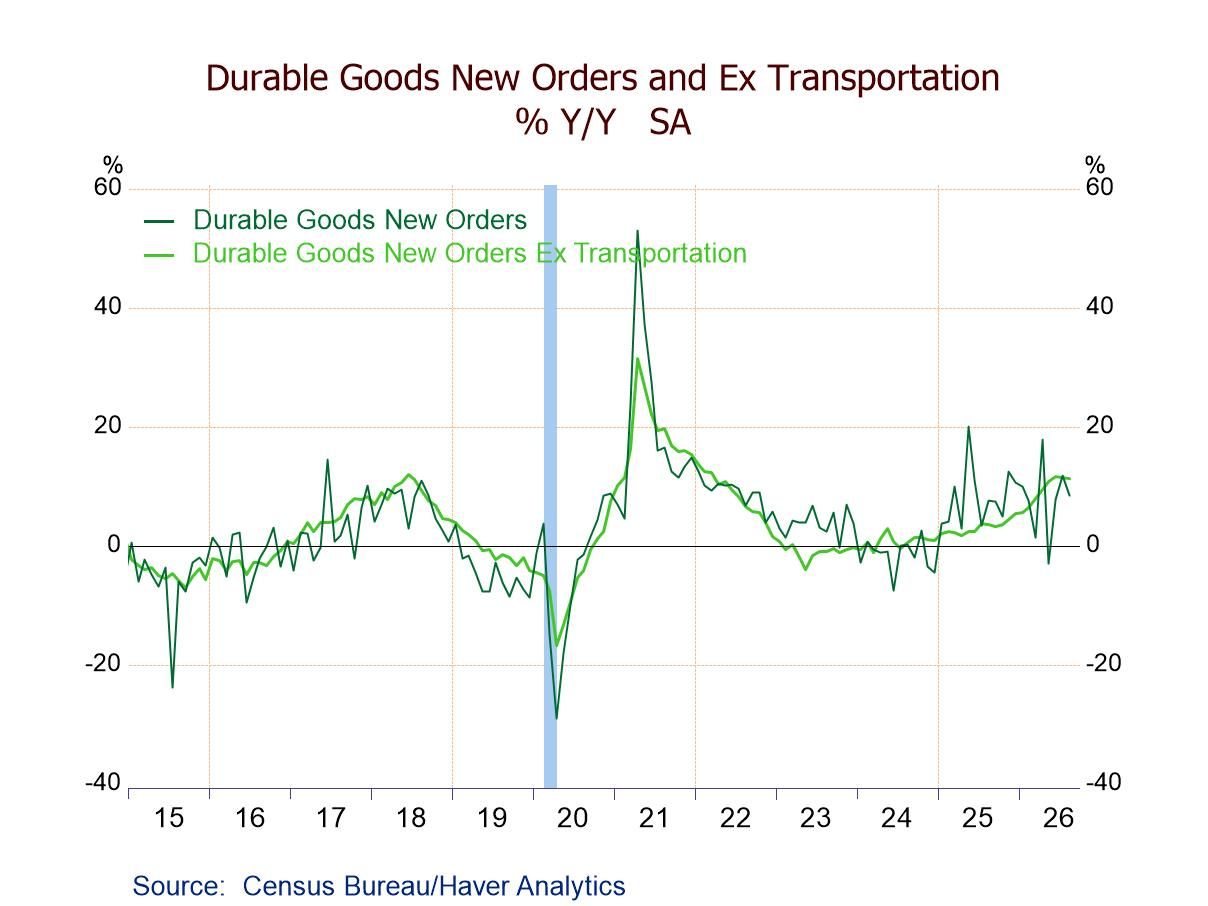
Durable goods orders rose 0.8% (0.9% y/y) in March after a 1.2% decline in February (matching +0.8% m/m in the advance report on April 29), marking the first m/m gain since November. The March m/m orders rise reflected a 0.8% rebound (-10.4% y/y) in transportation equipment—the first m/m increase in four months—following a 5.6% February drop, alongside m/m gains of 3.6% (15.0% y/y) in computers & electronic products, 0.9% (10.5% y/y) in machinery, 0.8% (6.3% y/y) in electrical equipment, appliances & components, and 0.5% (10.3% y/y) in primary metals. Durable goods orders for furniture & related products, however, slipped 0.2% (+0.8% y/y) in March, the fourth consecutive m/m decline, after a 1.4% drop in February. Meanwhile, orders for fabricated metal products were virtually unchanged (+6.9% y/y) following 1.1% February increase.
Nondurable goods orders, which equal nondurable goods shipments, advanced 2.1% (3.4% y/y) in March, the biggest of four successive m/m gains, after a 1.9% rise in February. The March m/m increase was led by a 9.9% jump (8.5% y/y) in petroleum & coal products, followed by gains of 1.1% (4.9% y/y) in chemical products, 0.6% (4.3% y/y) in beverage & tobacco products, 0.6% (1.9% y/y) in plastics & rubber products, and 0.2% (-1.6% y/y) in textile products. To the downside, the following nondurable goods shipments fell m/m in March: leather & allied products (-2.4%; -7.2% y/y), textile mills (-1.4%; -4.2% y/y), printing (-0.9%; -1.8% y/y), paper products (-0.4%; +0.8% y/y), apparel (-0.2%; +2.7% y/y), and food products (-0.2%; +0.4% y/y).
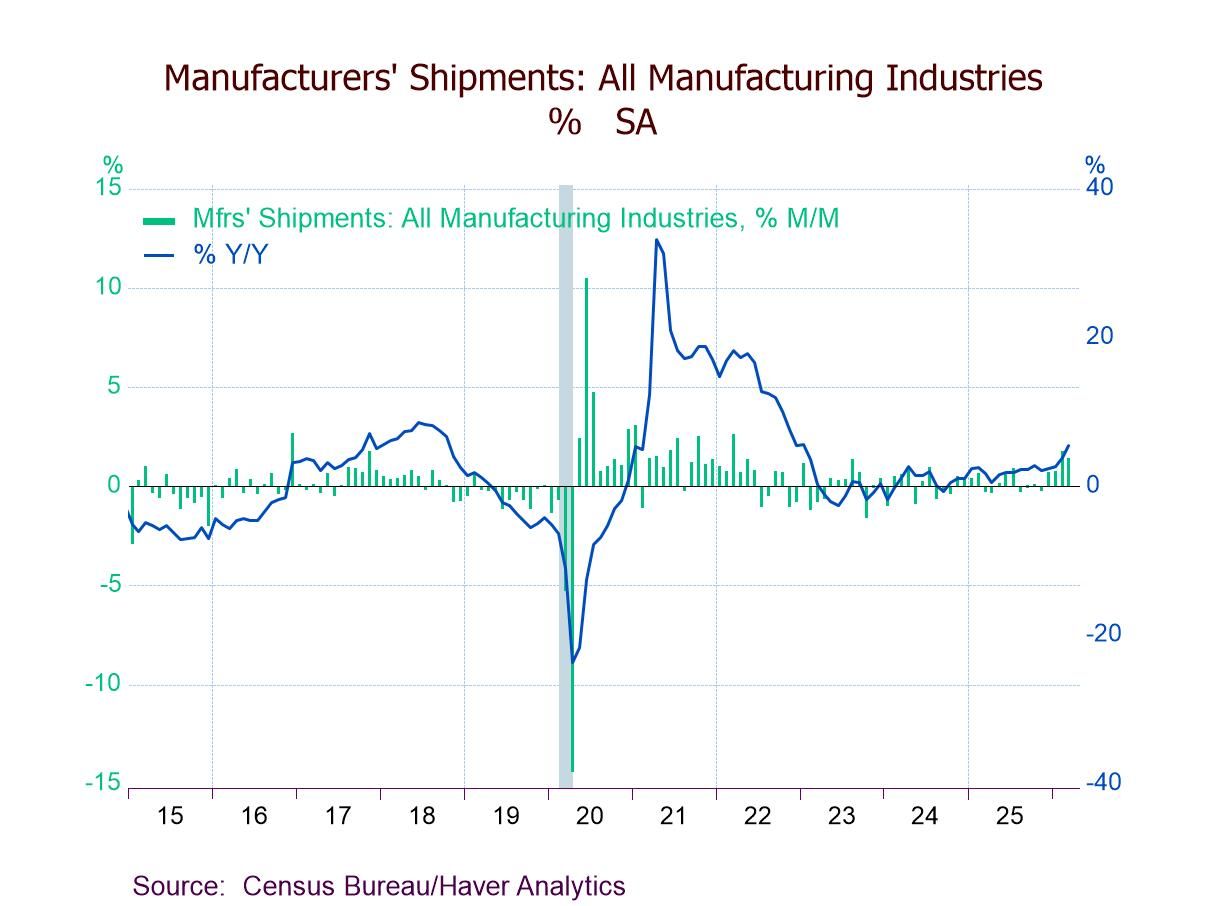
Total shipments rose 1.4% (5.5% y/y) in March, up for the fourth consecutive month, after increases of 1.7% in February and 0.7% in January. Excluding transportation, shipments grew 1.6% (4.5% y/y), the fifth straight m/m gain, following a 1.7% February rise. Shipments of durable goods industries rose 0.7% (7.7% y/y), the fourth successive m/m increase, after a 1.6% February rise. This reflected m/m gains across nearly all durable goods shipments categories, led by a 2.3% advance (9.7% y/y) in machinery, followed by rises of 0.8% (6.4% y/y) in fabricated metal products, 0.8% (11.0% y/y) in transportation equipment, 0.5% (6.2% y/y) in computers & electronic products, 0.5% (3.2% y/y) in miscellaneous durable goods, 0.5% (-2.4% y/y) in wood products, 0.2% (4.7% y/y) in electrical equipment, appliances & components, 0.2% (3.2% y/y) in nonmetallic mineral products, and 0.1% (9.6% y/y) in primary metals. In contrast, durable goods shipments for furniture & related products were the only category with a monthly decline in March, dropping 1.2% (+2.3% y/y) following a 1.7% February rebound.
Unfilled orders edged up 0.1% (9.4% y/y) in March, the eighth consecutive m/m increase, following a 0.1% uptick in February. Excluding transportation, unfilled orders rose 0.3% (2.5% y/y), also up for the eighth straight month, after a 0.3% February rise. Backlogs of durable goods ticked up 0.1% (9.4% y/y) in March, led by gains of 0.9% (1.5% y/y) in computers & electronic products and 0.4% (5.3% y/y) in electrical equipment, appliances & components, partially offset by a 0.6% decline (+0.2% y/y) in furniture & related products.
Inventories rose 0.6% (1.3% y/y) in March, the largest of five successive m/m gains, following a 0.1% increase in February. Excluding transportation, inventories grew 0.7% (1.5% y/y) after edging up 0.1% in February. Durable goods inventories rose 0.3% (1.9% y/y) in March after inching up 0.1% in February, while nondurable goods inventories advanced 1.2% (0.3% y/y) following a 0.1% February uptick and declines of 0.3% in January and December.
The factory sector data are available in Haver’s USECON database. The Action Economics Forecast Survey is in the AS1REPNA database.

Winnie Tapasanun
AuthorMore in Author Profile »Winnie Tapasanun has been working for Haver Analytics since 2013. She has 20+ years of working in the financial services industry. As Vice President and Economic Analyst at Globicus International, Inc., a New York-based company specializing in macroeconomics and financial markets, Winnie oversaw the company’s business operations, managed financial and economic data, and wrote daily reports on macroeconomics and financial markets. Prior to working at Globicus, she was Investment Promotion Officer at the New York Office of the Thailand Board of Investment (BOI) where she wrote monthly reports on the U.S. economic outlook, wrote reports on the outlook of key U.S. industries, and assisted investors on doing business and investment in Thailand. Prior to joining the BOI, she was Adjunct Professor teaching International Political Economy/International Relations at the City College of New York. Prior to her teaching experience at the CCNY, Winnie successfully completed internships at the United Nations. Winnie holds an MA Degree from Long Island University, New York. She also did graduate studies at Columbia University in the City of New York and doctoral requirements at the Graduate Center of the City University of New York. Her areas of specialization are international political economy, macroeconomics, financial markets, political economy, international relations, and business development/business strategy. Her regional specialization includes, but not limited to, Southeast Asia and East Asia. Winnie is bilingual in English and Thai with competency in French. She loves to travel (~30 countries) to better understand each country’s unique economy, fascinating culture and people as well as the global economy as a whole.
More Economy in Brief
 Global