German Confidence in June (GfK) Remains Extremely Weak
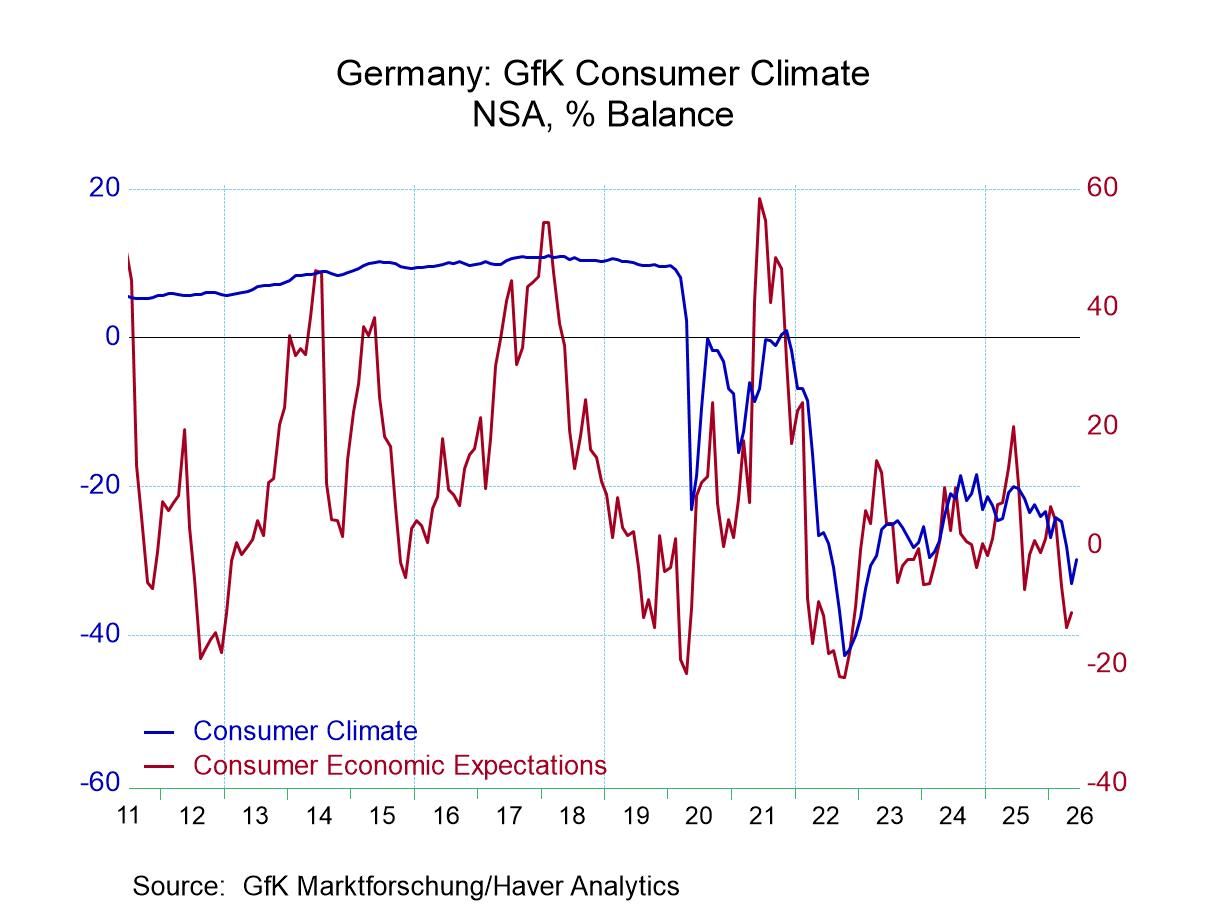
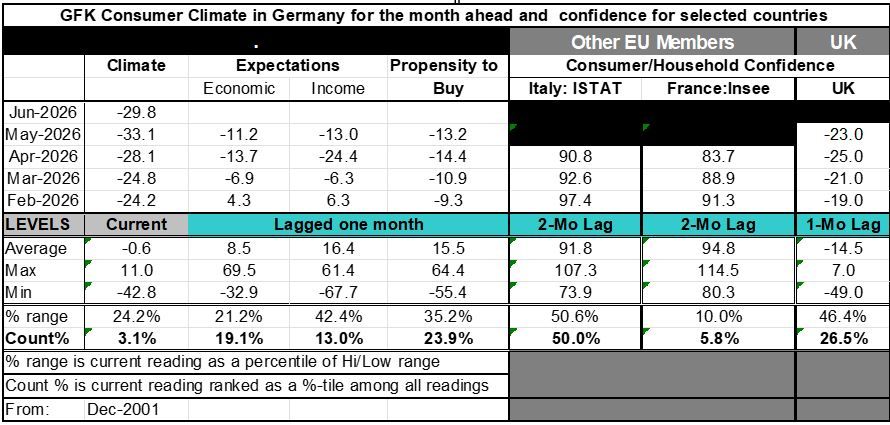
GfK consumer climate for Germany improves slightly to -29.8 in June from -33.1 in May. In terms of monthly point changes, it's a reasonable improvement month-to-month however this is now the 10th weakest monthly consumer climate reading over the last 25 years and so it's an extremely weak reading. Last month was an even weaker reading, but that was the 7th weakest reading all time for this index. All the other even weaker readings were during Covid. This is a very weak report, it ranks 286th out of 296 observations.
A very weak month despite some technical improvement GfK projects a climate figure for June, however, it's underlying data for components are up to date through May. As of May, economic expectations improved slightly to -11.2 from -13.7. Income expectations improved a lot more to -13.0 from -24.4. However, that -24.4 figure was a collapse from -6.3 the month before, so that the rebound in May still leaves a significant net decline over the last two months. We should not be too focused on the month-to-month improvement. Income expectation’s April reading was likely a shock reaction to global events in the Middle East. The propensity to buy index improved to -13.2 in May from -14.4 but once again it's a case of there still being a 2-month decline on the books since the March reading was -10.9 for the propensity to buy. The even weaker propensity to buy readings historically were all in the wake of Covid.
Very weak rank standing On the whole it's another week reading from the GfK survey. This is further underscored by the rank- or the count-percentile standing of the headline which stands in its lower 3.1 percentile. Economic expectations are in their lower 19th-percentile, income expectations are in their lower 13th-percentile and the propensity to buy is in its lower 23.9-percentile. All of these are rankings that are infrequently weaker than their readings in May.
Select European comparisons As a comparison I include the most up-to-date readings for Italy, France, and the UK on confidence. Italy and France have up-to-date readings through April; the UK has an up-to-date reading through May. The three countries all show declines in confidence from April to May; the UK shows a slight improvement from May to June. If we look at the most current readings, the percentile standing for Italy is a 50-percentile standing, which implies that the current reading is right on top of its median. For France it's a 5.8 percentile standing, marking the reading as weaker less than 6% of the time. For the UK, the May standing is a 26.5 percentile standing, just above the lower quartile of its historic queue of data.
Wrap up There was nothing reassuring in these data. The economies are struggling as we saw in the S&P PMI data from yesterday from the early reporters of PMI statistics. Of course, the inflation data are uniformly poor globally, so it remains a difficult time and the consumers are feeling a good deal of pressure from inflation and a certain amount of economic uncertainty.

Robert Brusca
AuthorMore in Author Profile »Robert A. Brusca is Chief Economist of Fact and Opinion Economics, a consulting firm he founded in Manhattan. He has been an economist on Wall Street for over 25 years. He has visited central banking and large institutional clients in over 30 countries in his career as an economist. Mr. Brusca was a Divisional Research Chief at the Federal Reserve Bank of NY (Chief of the International Financial markets Division), a Fed Watcher at Irving Trust and Chief Economist at Nikko Securities International. He is widely quoted and appears in various media. Mr. Brusca holds an MA and Ph.D. in economics from Michigan State University and a BA in Economics from the University of Michigan. His research pursues his strong interests in non aligned policy economics as well as international economics. FAO Economics’ research targets investors to assist them in making better investment decisions in stocks, bonds and in a variety of international assets. The company does not manage money and has no conflicts in giving economic advice.
More Economy in Brief
 Global