

 Global| Sep 23 2026
Featured Data Additions, September 23, 2026
Summary
- Electricity supply statistics for Bhutan were added to the ENERGY database.
- Tax, social security and customs revenue statistics for Argentina were added to the EMERGELA database.
- Monetary policy diffusion indexes were added to EIURSKF.
ENERGY → Country-Sourced Statistics → Bhutan → Production, Exports and Sales of Major Hydropower Projects
Electricity supply statistics for Bhutan were added to the ENERGY database. Production, exports and domestic sales of hydropower by nine major hydropower plants are present on this table. In addition, quantity and costs of total electricity and solar power are available on a separate table. Monthly series reported in kWh and BTN are sourced from the Royal Monetary Authority and start as early as January 2010.
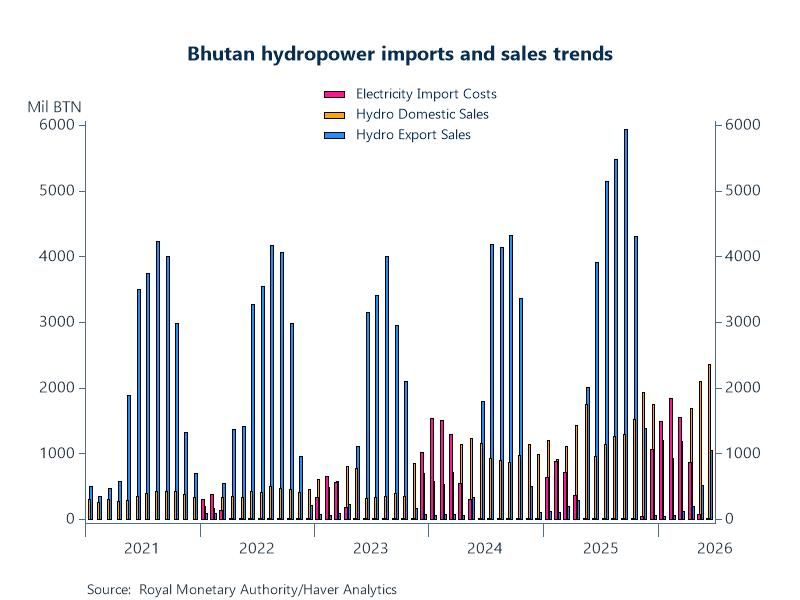
Chart: YTD domestic hydropower sales in June 2026 totaled 9.4 billion BTN compared to 1.7 billion BTN just 5 years prior. This reflects Bhutan’s expanding energy demand, driven by economic development, industrialization and greater household consumption. Its growing dependence on hydropower makes its energy production susceptible to seasonal variations in water flow, causing reduced capacity during lean seasons. Bhutan became a net importer of electricity in 2022 which highlights the difficulty in meeting peak winter demand and the need for more reliable or diversified energy sources to avoid shortages.
EMERGELA → Argentina → Public Finance and Debt → Tax, Social Security, and Customs Revenue
Tax, social security and customs revenue statistics for Argentina were added to the EMERGELA database. This table includes almost fifty line items of government revenue sources. Monthly data reported in Argentine pesos are sourced from Agencia de Recaudacíon y Control Aduanero and start as early as January 2003.
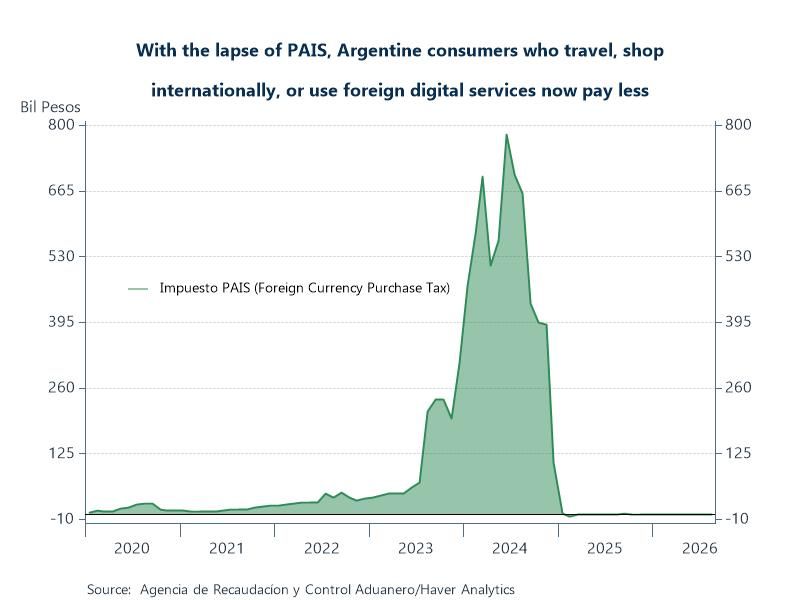
Chart: The PAIS tax was originally created in December 2019 under a 5-year mandate meant to curb capital flight amid chronic dollar scarcity. Milei initially raised it out of pure fiscal necessity, as it was one of the fastest levers available to raise cash while a broader stabilization plan was being implemented. PAIS became a major revenue source during this transitional period. In June 2024, it generated a record 780 billion pesos and over 2024 it collected 6.27 trillion pesos. PAIS expired in early 2025 and was not renewed, making it the most consequential individual tax change of the past few years in Argentina.
EIURSKF → Central Bank Diffusion Index
Monetary policy diffusion indexes were added to EIURSKF. These data track the direction and intensity of monetary policy shifts across 43 geographic and thematic aggregates. (+) values signal net monetary tightening, whereas (-) values signal net easing. They can be used to monitor synchronization in monetary policy, compare policy stances across regions, and evaluate cross-border investment and risk assessments. Monthly, quarterly and annual data are sourced from the EIU and start in 2010. Quarterly forecasts currently extend through the end of 2027 – annual forecasts through 2030.
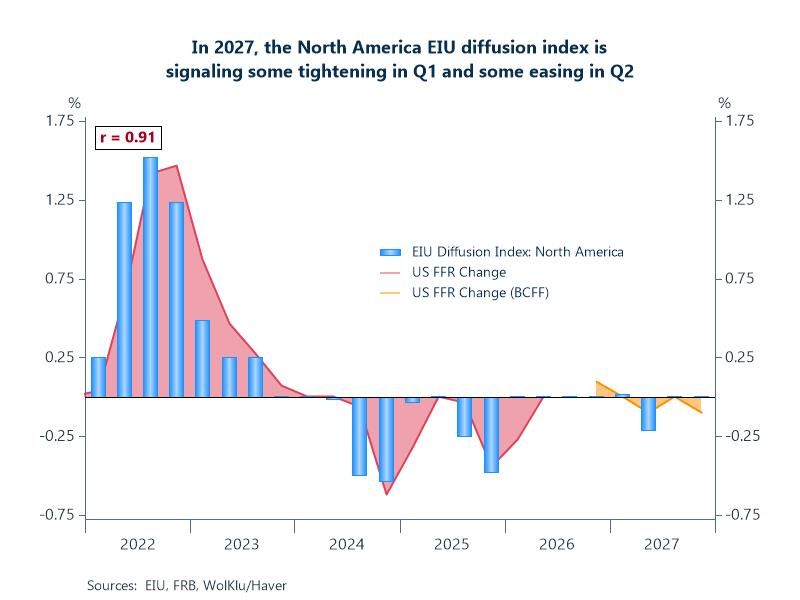
Chart: There is a high degree of correlation between the EIU diffusion index for North America and the actual changes in the US FFR. The indexes are weighted by size of each country’s economy, so this correlation makes sense. For 2027, the EIU diffusion index is signaling policy rate tightening to continue into Q1 with all easing occurring in Q2, however, this can change as the EIU data is updated on a weekly basis. The current BCFF is projecting no additional tightening in 2027 with some easing in Q2 and Q4.
More Featured Data Additions
 Global| Sep 18 2026
Featured Data Additions, September 18, 2026
 Global| Sep 02 2026
Featured Data Additions, September 2, 2026
 Global| Aug 27 2026
Featured Data Additions, August 27, 2026
 Global| Aug 19 2026