

 Global| Oct 14 2026
Featured Data Additions, October 14, 2026
Summary
- The RPLS were added for the US to USECON and by state in REGIONAL.
- Port statistics for South Korea were added to the TRANSPRT database.
- Iron and steel production statistics for Argentina were added to the GLSECTOR database.
USECON/REGIONAL → Employment and Earnings → Revelio Labs Public Labor Statistics (RPLS)
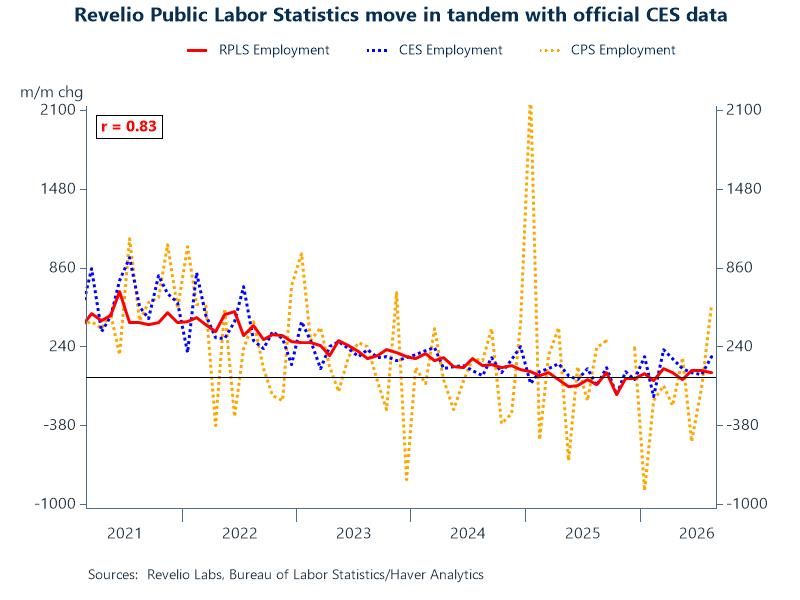
The RPLS were added for the US to USECON and by state in REGIONAL. Revelio Labs is a workforce research and data company that draws on a proprietary dataset of over 100 million professional profiles on networking platforms, capturing roughly 2/3 of all employed individuals in the US, to produce granular insights into employment, hirings, separations and wages. Monthly data are released the day before the BLS Employment Situation report and start in January 2021.
Chart: When we compare Revelio’s estimated m/m employment changes to the BLS’s establishment survey estimated employment changes, we find that Revelio’s estimates capture the same broad trends with a strong correlation of 0.82. The correlation between the BLS establishment and household surveys is relatively modest at 0.31, reflecting their differences in methodology and coverage. Revelio’s correlation with the household survey is similarly modest at 0.29, indicating the much closer alignment with the payroll-based employment measures.
TRANSPRT → Port Statistics by Country → South Korea → Trade by Port
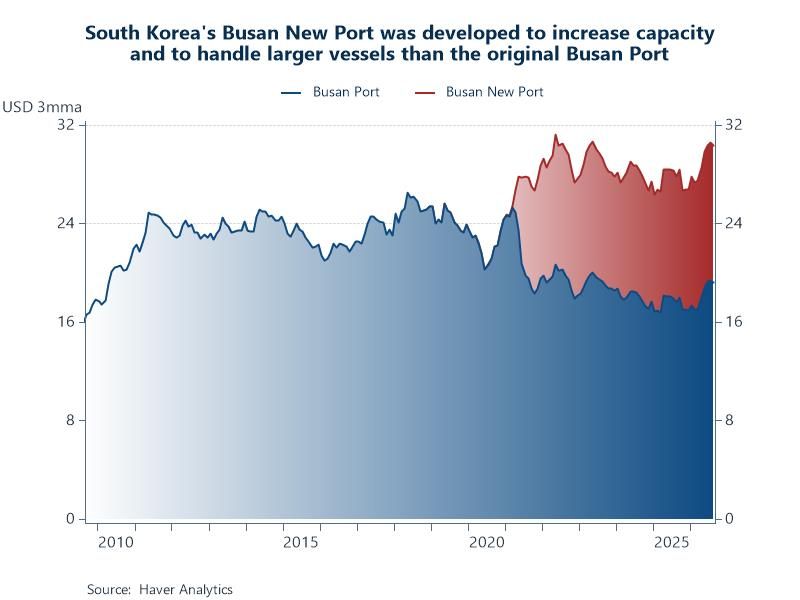
Port statistics for South Korea were added to the TRANSPRT database. Nearly all trade in South Korea moves by sea, as it is effectively an island economy since North Korea closes off all land routes. Exports and imports in USD and in metric tons were added for 44 ports around the country. Monthly data sourced from the Korea International Trade Association start as early as January 1988.
Chart: Busan is Korea’s oldest, largest and one of the busiest container ports in the world. By the 1990s, container volumes and ship sizes were outgrowing its terminals. Korea needed more modern, larger-scale capacity if it was to reach its goal of becoming a NE Asian transshipment hub. Busan New Port was developed with its deep water, large modern terminals and better road and rail connections. Some capacity did move from the old to the new port, but the net effect was increased capacity of roughly 15-20% in value terms. Approximately 30 billion USD worth of goods currently flow in and out of the Busan Port complex on a monthly basis.
GLSECTOR → Selected Indicators by Country → Argentina → Iron and Crude Steel Production
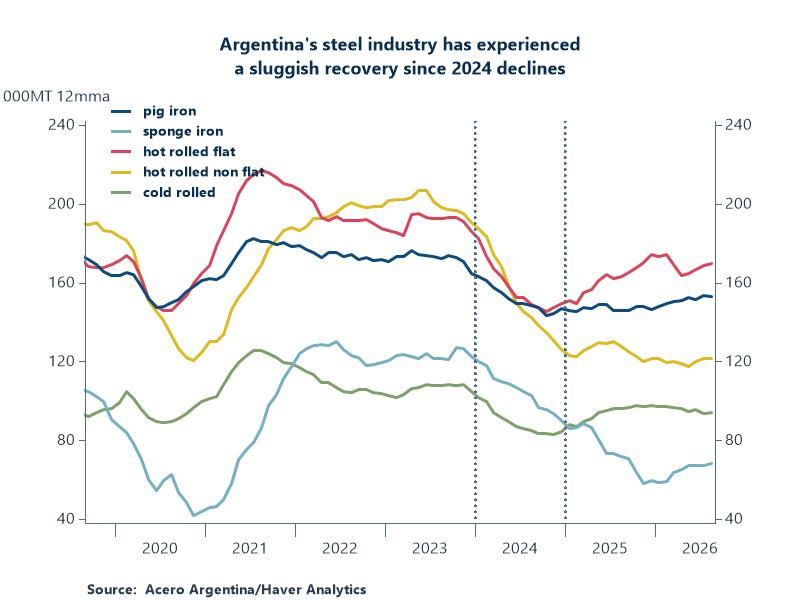
Iron and steel production statistics for Argentina were added to the GLSECTOR database. Series reported in MT are available for primary iron production including pig and sponge iron, crude steel production and hot and cold rolled steel production including detail for flat and non-flat products. Monthly data are sourced from Acero Argentina and start in January 2016.
Chart: In 2024, the Argentinian economy contracted 1.3% as Millei’s stabilization program was taking hold. The steel industry was hit badly and y/y production decreased across the board. The industry has a scale and cost disadvantage against Brazil and China, is highly concentrated, and has a heavy dependence on the macro cycle. Under current policies, protection from imports is lower, the currency is stronger, and domestic demand is anemic. Energy-linked demand is one of the only drivers, which favors hot rolled flat products. This category has shown the most recovery since the 2024 downturn.
More Featured Data Additions
 Global| Oct 07 2026
Featured Data Additions, October 7, 2026
 Global| Sep 23 2026
Featured Data Additions, September 23, 2026
 Global| Sep 18 2026
Featured Data Additions, September 18, 2026
 Global| Sep 02 2026