

 Global| Nov 24 2026
Contradictions
by:Andrew Cates
|in:Viewpoints
Recent volatility in technology stocks has highlighted concerns about the sustainability of the AI investment boom. Yet while equity investors have questioned prospective returns on that investment, bond markets continue to price further monetary tightening. The global economy could withstand a substantial correction in technology valuations. Its ability to do so would be diminished, however, if monetary policy became more restrictive as investment and demand weakened.
Three distinctions are important in assessing these risks: between financial valuations and economic activity; between nominal and real measures of technology demand; and between shareholder losses and broader financial instability. Recent economic and financial data suggest that the consequences of an AI correction need not be as severe for the global economy as for financial markets.
Financial markets versus economic activity The recent divergence between copper prices and global manufacturing activity illustrates the first of these distinctions. Having moved broadly in tandem for much of the past three years, copper prices have fallen sharply since the summer even as manufacturing surveys have continued to improve.
Chart 1: Copper prices and the global manufacturing PMI
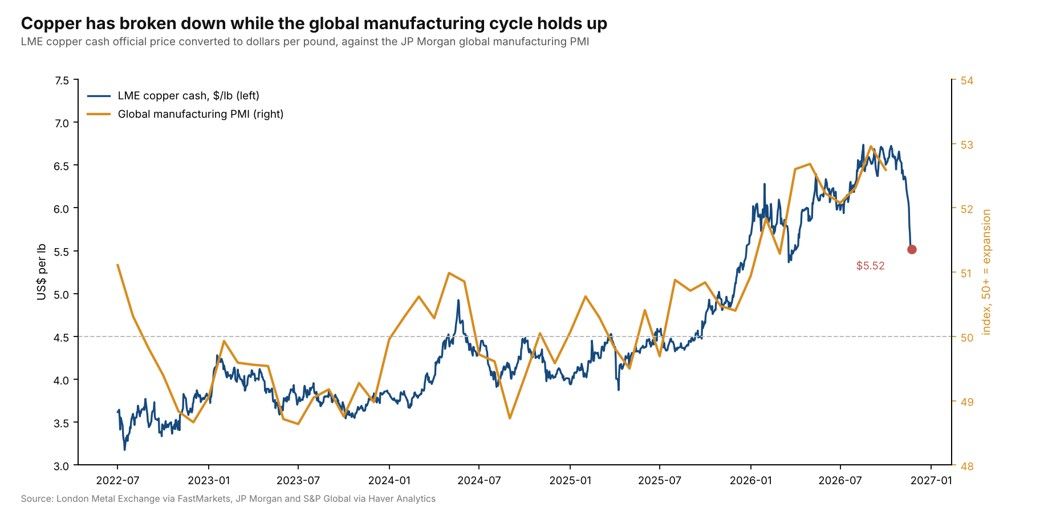
While copper prices may be anticipating weaker industrial demand, they are also sensitive to developments in China's property sector, fluctuations in the dollar and shifts in investor sentiment. More compelling evidence of an impending downturn would be a broad deterioration in manufacturers' order books, particularly in Asia's technology-intensive economies.
Strong demand, narrow foundations Taiwan's export orders offer an early indication of global technology demand. Their recent strength provides little evidence of an imminent reversal in the AI investment cycle.
Chart 2: Taiwan export orders, by destination and by product
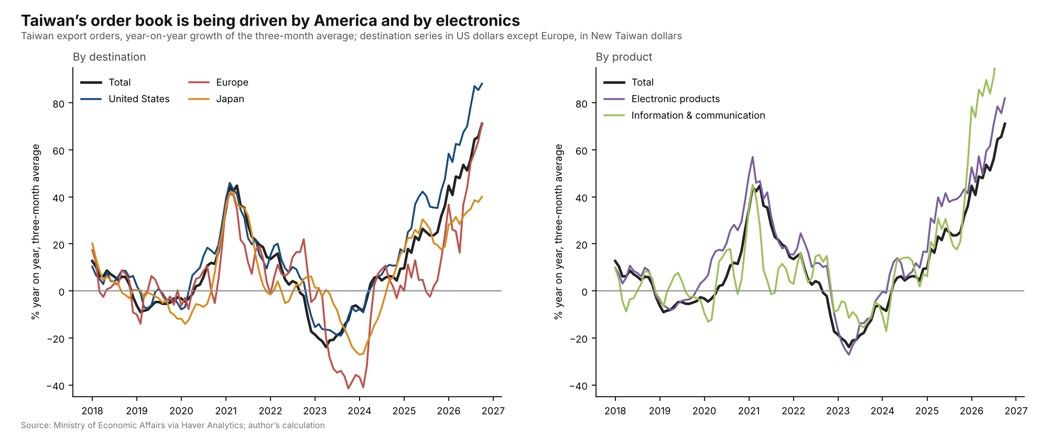
The composition of that growth is less reassuring. American customers account for much of the increase, while electronics and communications equipment dominate the product breakdown. Much of the improvement reflects a highly concentrated US investment boom.
This may partly explain the divergence between copper prices and manufacturing activity: weakness in traditional sources of industrial demand is being offset by technology-related investment. But assessing the consequences of a reversal also requires distinguishing between growth in prices and volumes.
Nominal versus real technology demand South Korea's semiconductor exports illustrate the importance of that distinction. Export receipts have risen by well over 200% over the past year, while volumes have increased at roughly a tenth of that rate. Higher memory prices explain much of the difference.
Chart 3: Korean semiconductor exports, value against volume
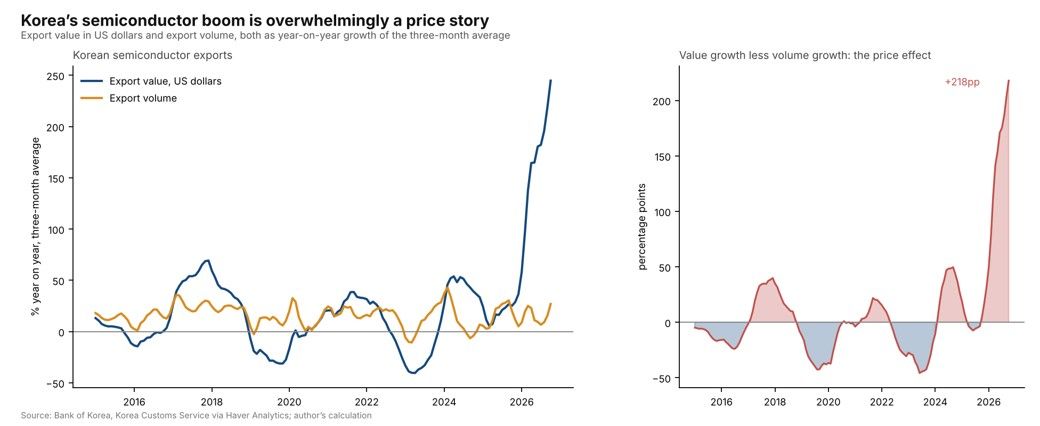
A reversal in semiconductor prices could therefore generate substantial losses in export earnings, corporate profits and equity valuations without an equivalent decline in production. Lower input costs could, moreover, benefit businesses elsewhere in the economy.
Falling profitability could nevertheless discourage investment in semiconductor production, while declining shipment volumes would signal a more substantive deterioration in demand. The wider economic consequences would also depend on how readily financial losses were transmitted through the credit system.
Financial stability and credit conditions The growing use of debt to finance AI-related investment is a legitimate concern. So far, however, recent equity market volatility has generated relatively little stress in broader US credit markets. Credit spreads have widened only modestly from historically narrow levels, while broader financial conditions remain close to their long-run average. Across the major economies, meanwhile, companies in aggregate continue to save more than they invest, albeit by a diminishing margin.
These indicators offer some reassurance about corporate sector resilience, although they could conceal vulnerabilities among individual borrowers. A substantial retrenchment in AI investment or a broader tightening of credit availability would pose more significant risks to global growth. Neither is yet conspicuously apparent in the aggregate data.
Implications for inflation and monetary policy An unwinding of the AI boom through lower semiconductor prices and moderating capital expenditure could alleviate some of the inflationary pressures associated with the investment cycle. This would occur against a backdrop of falling energy prices.
Oil prices have declined by roughly a third from their spring peak, while a composite measure of oil prices and US economic surprises has fallen appreciably since September. Two-year Treasury yields have, however, barely responded.
Chart 4: Oil prices and US growth surprises against the two-year yield
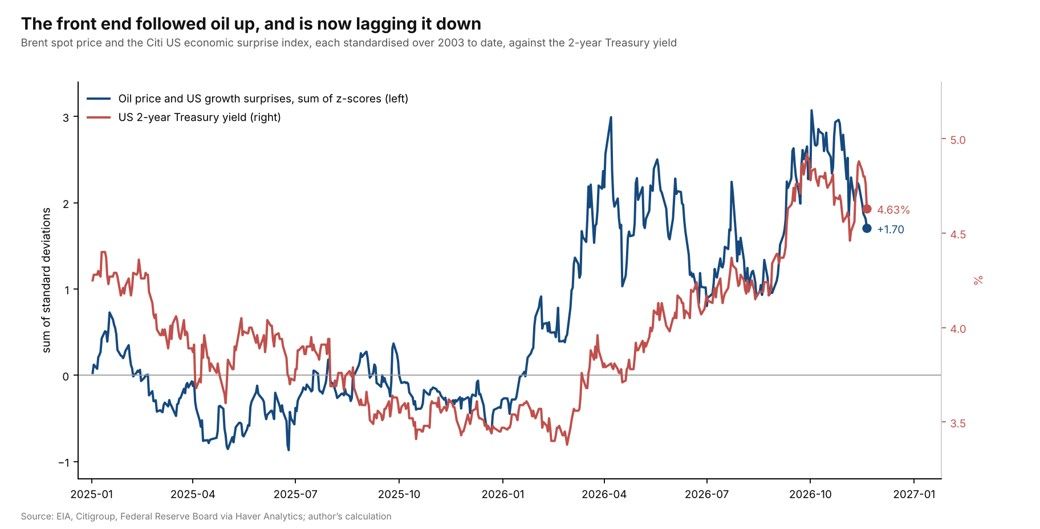
Cheaper energy should reduce headline inflation and support household purchasing power. A moderation in technology investment could simultaneously ease pressures on scarce resources. While much will depend on wages and services inflation, the prospective balance of risks to growth and inflation may be shifting.
A disconnect in monetary policy expectations Developments in the US yield curve reinforce that impression. Two-year Treasury yields have risen by more than their ten-year counterparts over the past year. While concerns about government borrowing can help explain elevated long-term yields, the disproportionate increase at the short end points more directly to expectations of restrictive monetary policy.
Chart 5: US Treasury yields and the gap between them
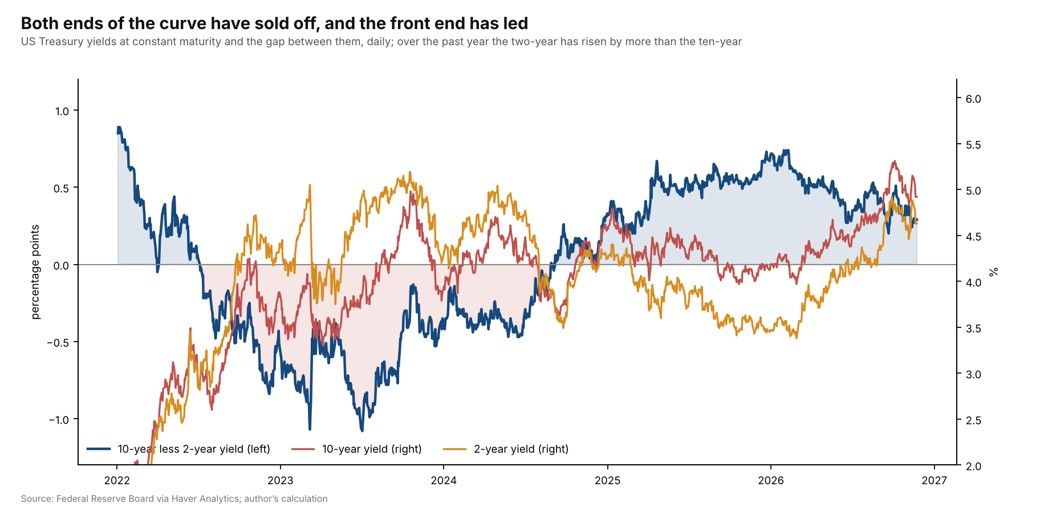
In recent years, two-year yields have tended to follow developments in oil prices and economic surprises with a lag of roughly three months. Although that relationship should not be interpreted mechanically, it provides another reason to question prevailing interest rate expectations.
More fundamentally, equity investors are questioning the sustainability of an investment boom that has been an important source of global demand, while bond markets continue to price further monetary tightening. An unwinding of that boom, particularly alongside lower energy prices, could ultimately warrant a different policy response.
What to watch Asian export orders, semiconductor shipment volumes and corporate capital expenditure plans will provide early indications of whether financial-market volatility is influencing real economic activity. Credit spreads will help gauge the extent to which financial losses are spreading. Equally important will be the response of underlying inflation and monetary policy expectations to cheaper energy and any moderation in demand.
A correction in technology valuations need not precipitate a global recession. An excessively restrictive monetary policy could, however, materially increase that risk.

Andrew Cates
AuthorMore in Author Profile »Andy Cates joined Haver Analytics as a Senior Economist in 2020. Andy has more than 25 years of experience forecasting the global economic outlook and in assessing the implications for policy settings and financial markets. He has held various senior positions in London in a number of Investment Banks including as Head of Developed Markets Economics at Nomura and as Chief Eurozone Economist at RBS. These followed a spell of 21 years as Senior International Economist at UBS, 5 of which were spent in Singapore. Prior to his time in financial services Andy was a UK economist at HM Treasury in London holding positions in the domestic forecasting and macroeconomic modelling units. He has a BA in Economics from the University of York and an MSc in Economics and Econometrics from the University of Southampton.