U.S. Consumer Confidence Jumps in November to Highest Level Since January ’25
Summary
- Headline up 11.4 pts. to 103.3 in Nov., above expectations; 20.5% above the April ’25 low.
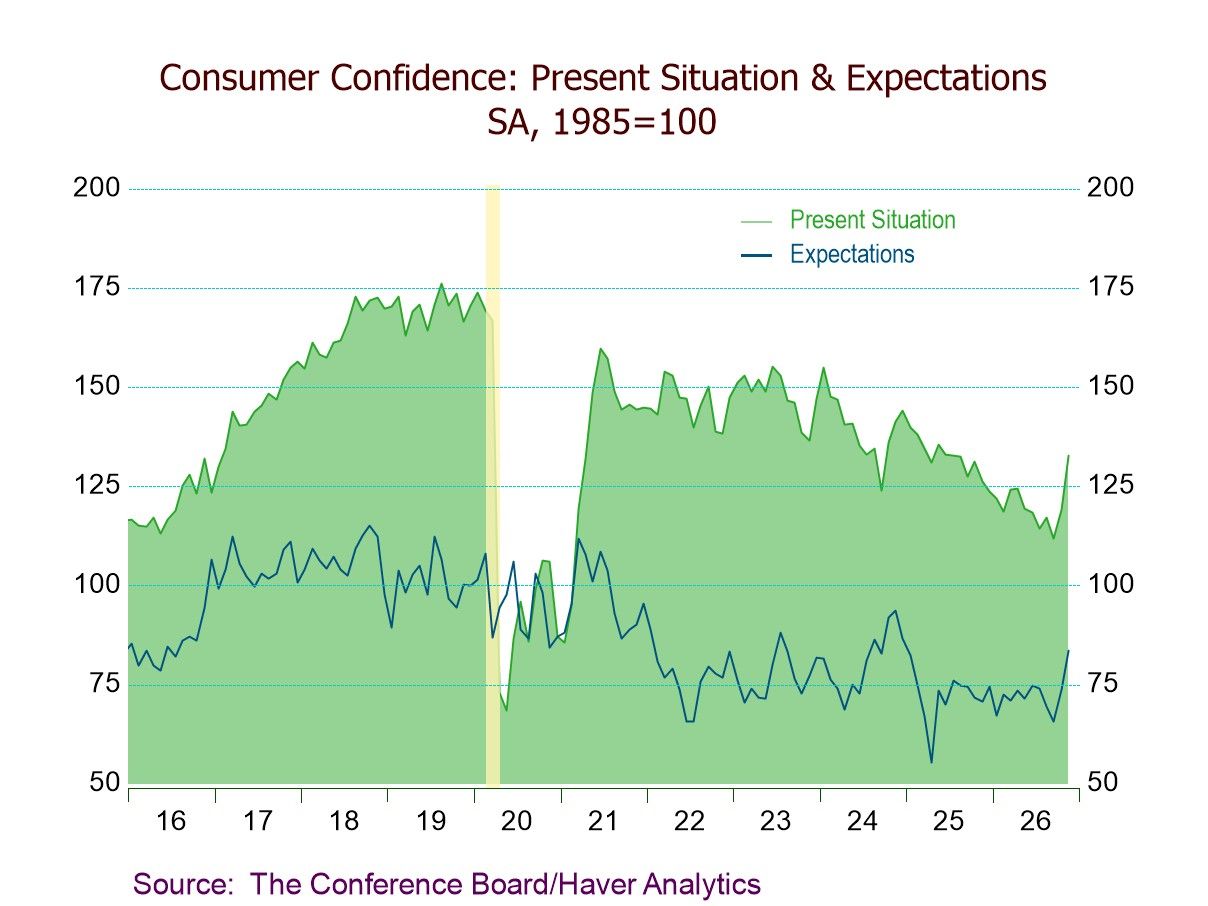
- Present Situation Index up 13.7 pts. to 132.8, strongest since July ’25.
- Expectations Index up 9.9 pts. to 83.6, highest since Dec. ’24.
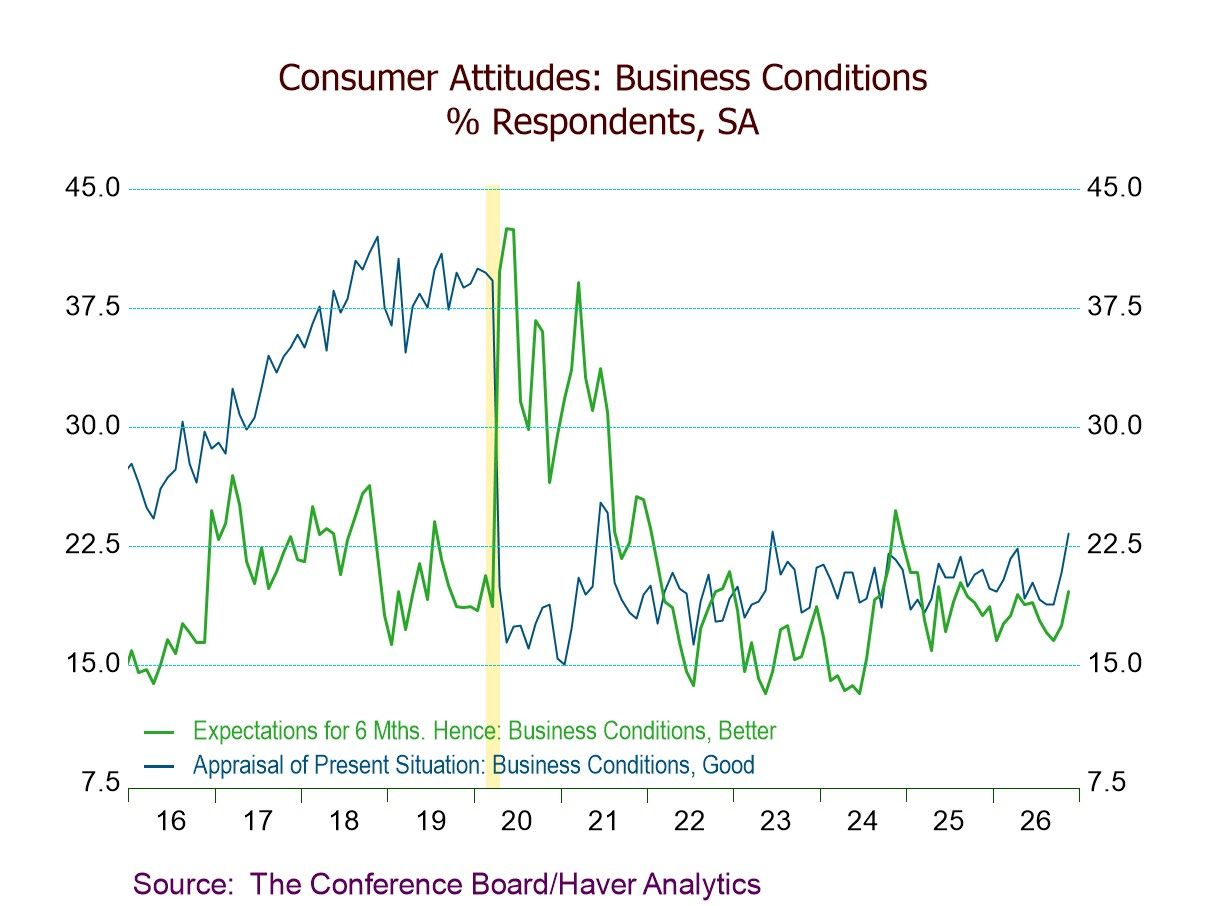
- Consumers more optimistic about current & future business, labor market, and financial conditions, likely due to lower uncertainty after the midterm elections.
- Labor market differential up to 12.4%, highest since May ’25, from October’s 4.8%, signaling stronger labor market conditions.
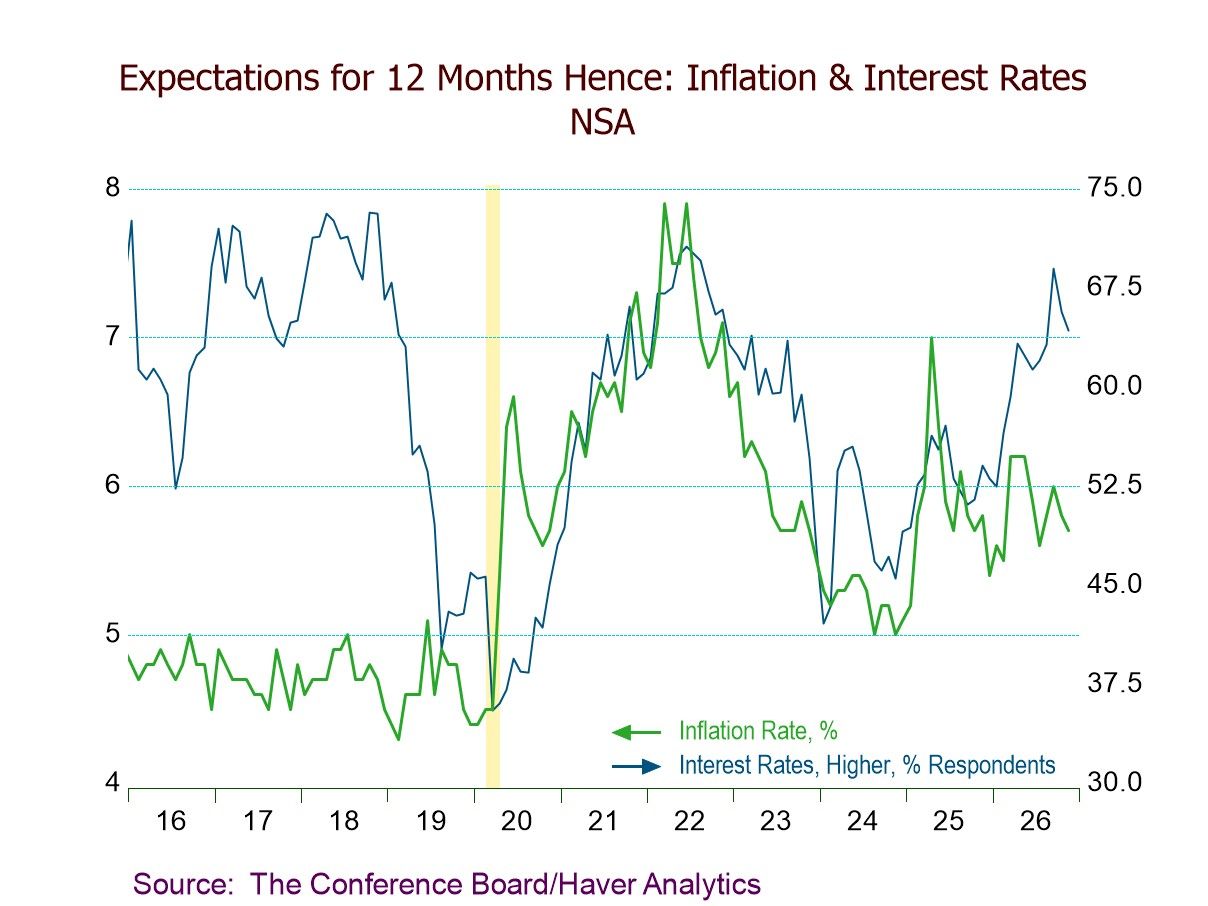
- Inflation expectations down marginally to 5.7%, lowest since July amid lower oil prices, but still elevated.
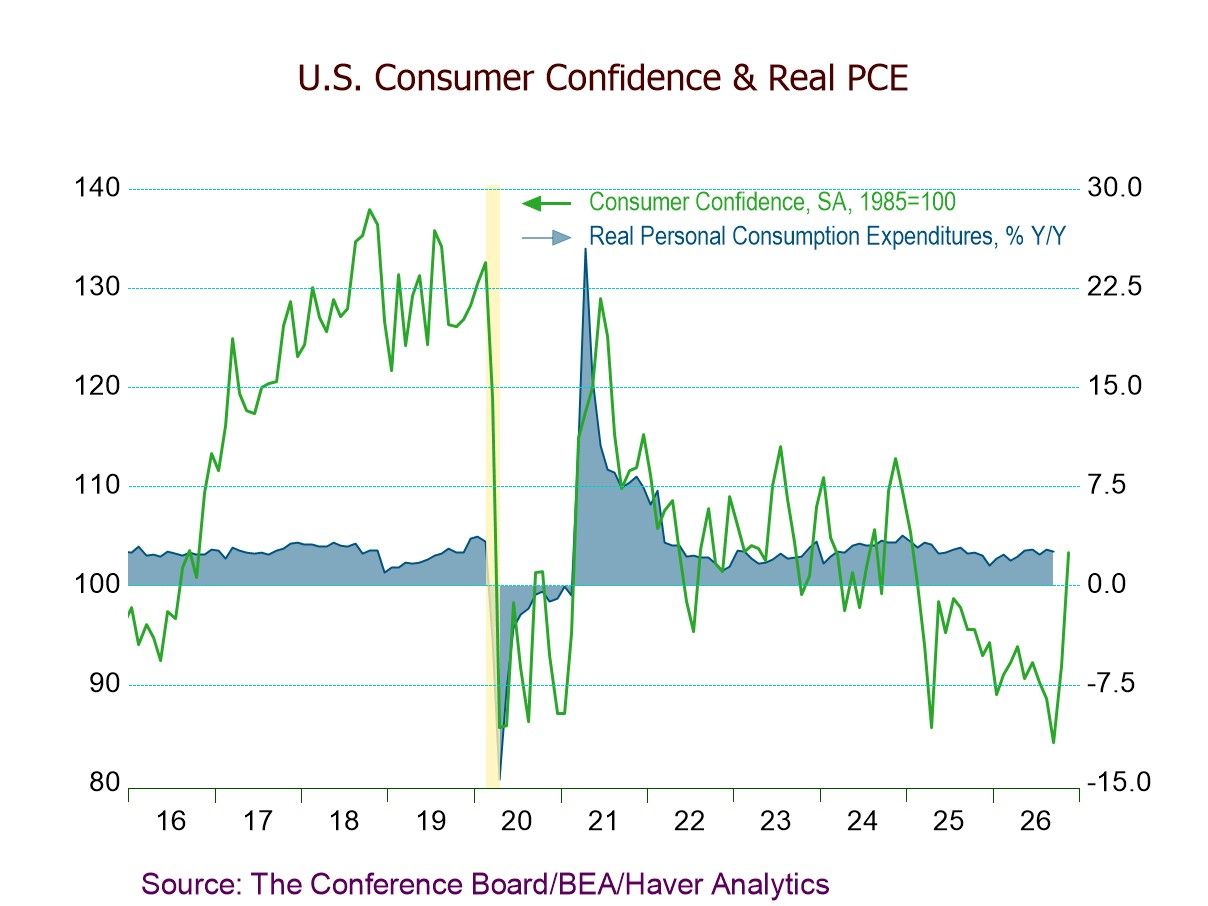
Amid rising optimism about the overall economy and labor market following the midterm elections, the Conference Board U.S. Consumer Confidence Index jumped 12.4% m/m (11.2% y/y) to a higher-than-expected 103.3 in November after an upwardly revised 9.1% gain to 91.9 in October (+8.9%; 91.7 initially) and three straight m/m declines. November marked the highest level since January 2025 (105.3). A reading of 92.1 had been expected in the Action Economics Forecast Survey. The latest reading was higher than 92.9 in November 2025 and 20.5% above a low of 85.7 in April 2025, albeit remaining 8.4% below a high of 112.8 in November 2024.
Consumers' views of present economic conditions strengthened for the third time in four months in November, while the views of future economic conditions advanced for the second consecutive month. The Present Situation Index—which assesses current business and labor market conditions—advanced 11.5% m/m (5.1% y/y) to 132.8 in November, the third monthly rise in four months and matching the highest level since July 2025, following a 6.5% rebound to 119.1 in October. The index was 18.8% above its recent low of 111.8 in September and higher than 126.3 in November 2025 but 14.5% below a high of 155.3 in June 2023. The Expectations Index—which measures the short-term outlook for income, business, and labor market conditions—surged 13.4% m/m (18.2% y/y) to 83.6 this month, the highest level since December 2024, after a 12.2% jump to 73.7 in October and three successive m/m decreases. The index was higher than 70.7 in November 2025 and 50.9% above a low of 55.4 in April 2025, while remaining 10.8% below a high of 93.7 in November 2024.
Labor market readings showed more optimism this month. The jobs gap—representing the difference between respondents indicating that jobs are plentiful and those saying jobs are hard to get—climbed to 12.4% in November, the strongest reading since May 2025, from 4.8% in October. Calculated by Haver Analytics, this series had an 85% correlation with the unemployment rate over the last 20 years. The jobs plentiful measure rose to 30.8% of respondents in November, the highest reading since May 2025, from 26.2% in October. Perceptions of the current labor market improved, with the jobs hard-to-get measure declining to 18.4% this month, the lowest level since October 2025, from 21.4% in October.
Consumers generally viewed business conditions as more favorable compared to last month. Current business conditions were perceived as good by 23.3% of respondents in November, up from 20.8% in October and almost matching a high of 23.4% in June 2023. Expectations that business conditions would improve in six months were 19.6% of respondents, the highest since August 2025, up from 17.5% in October but below a high of 24.7% in November 2024. More jobs were expected in six months by 18.1% of respondents, the highest since May 2025, up from 15.3% in October but below a high of 22.8% in November 2024. The percentage expecting rising income held at 18.4% in November and October, down from its recent high of 20.7% in June but above a low of 14.4% in February 2023.
Inflation expectations eased for the second straight month in November amid lower oil prices but remained elevated. The expected inflation rate in twelve months dipped to 5.7% in November, the lowest since July, from 5.8% in October; it was below a high of 7.0% in April 2025 but above a low of 5.0% in November 2024. In November, 64.3% of respondents expected that interest rates would rise over the next twelve months, down from 65.7% in October but up from a low of 42.1% in January 2024.
The share of respondents planning to buy a home within six months increased to 6.9% in November from 6.0% in October; it was near its most recent high of 7.0% in April and above a low of 4.6% in February 2024. Those planning to buy automobiles rose to a four-month-high 12.9% of respondents this month from 10.7% in October; it was up from a low of 10.6% in April 2025. Meanwhile, the share of respondents planning a vacation within six months advanced to 44.9%, the highest since November 2025, from 42.7% in October.
The Consumer Confidence data are available in Haver’s CBDB database. The total indexes, which are indexed to 1985=100, appear in USECON, and market expectations are in AS1REPNA.

Winnie Tapasanun
AuthorMore in Author Profile »Winnie Tapasanun has been working for Haver Analytics since 2013. She has 20+ years of working in the financial services industry. As Vice President and Economic Analyst at Globicus International, Inc., a New York-based company specializing in macroeconomics and financial markets, Winnie oversaw the company’s business operations, managed financial and economic data, and wrote daily reports on macroeconomics and financial markets. Prior to working at Globicus, she was Investment Promotion Officer at the New York Office of the Thailand Board of Investment (BOI) where she wrote monthly reports on the U.S. economic outlook, wrote reports on the outlook of key U.S. industries, and assisted investors on doing business and investment in Thailand. Prior to joining the BOI, she was Adjunct Professor teaching International Political Economy/International Relations at the City College of New York. Prior to her teaching experience at the CCNY, Winnie successfully completed internships at the United Nations. Winnie holds an MA Degree from Long Island University, New York. She also did graduate studies at Columbia University in the City of New York and doctoral requirements at the Graduate Center of the City University of New York. Her areas of specialization are international political economy, macroeconomics, financial markets, political economy, international relations, and business development/business strategy. Her regional specialization includes, but not limited to, Southeast Asia and East Asia. Winnie is bilingual in English and Thai with competency in French. She loves to travel (~30 countries) to better understand each country’s unique economy, fascinating culture and people as well as the global economy as a whole.
More Economy in Brief
 Global