U.K. Distributive Trades Stabilize but Remain Weak
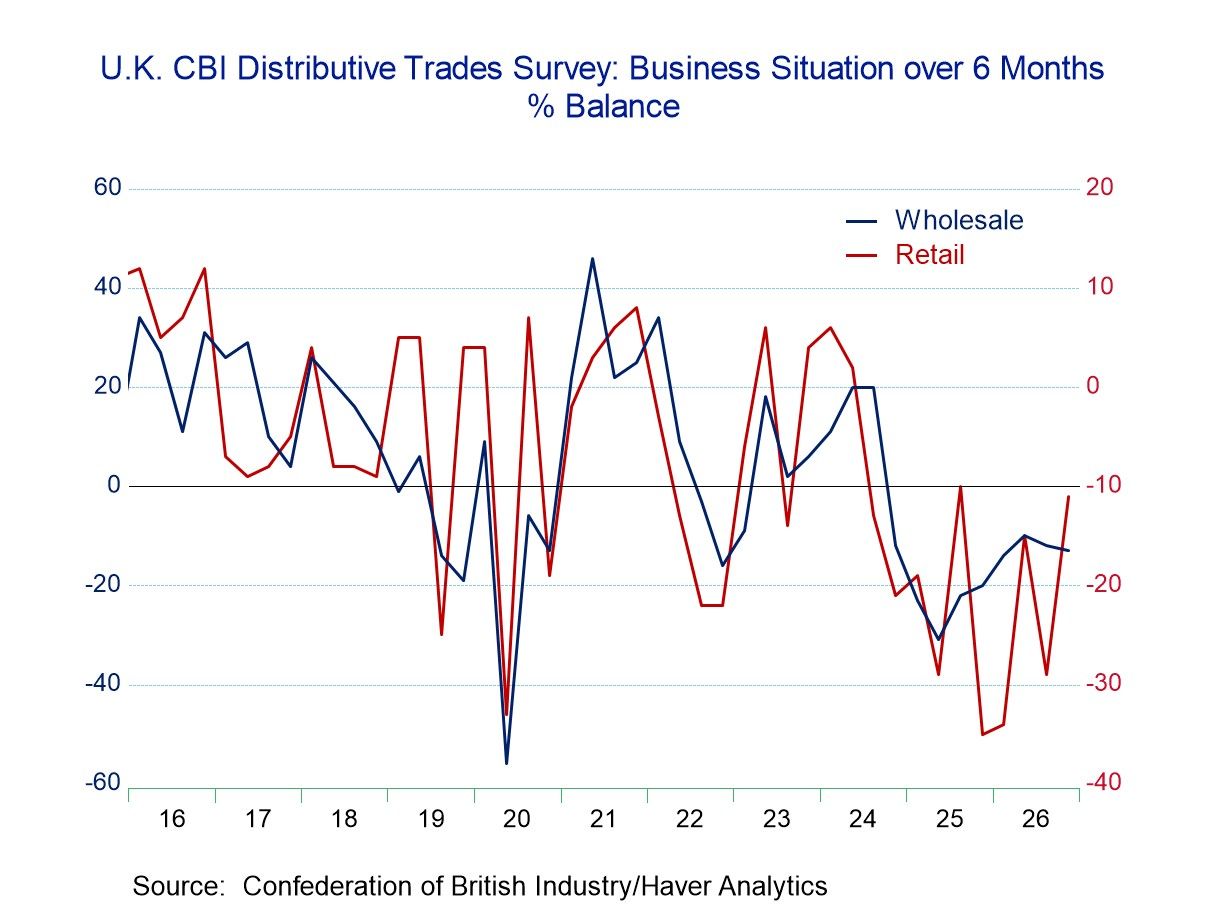
The U.K. distributive trades survey for the fourth quarter shows that there has been improvement in the distributive trades in the fourth quarter. Retailing has improved but it has not been dramatic, and it still leaves the rankings of the various components in a relatively weak position. One notable exception is employment with a 76.4 percentile standing; that gives it a very firm position and it's the one component that shifted radically stronger in the fourth quarter compared to the third quarter and has shown steady improvement from Q1 through Q4.
The business situation improved to -11 in the fourth quarter from -29 in the third quarter and improved over the past four quarters by 24 survey points. Capital spending, which weakened slightly to a reading of -18 in Q4 from -16 in Q3, nonetheless improved by 24 points over the last four quarters as well. Actual selling prices moved lower to a reading of 23 in Q4 from 35 in Q3 and declined by 23 survey points over four quarters, which would suggest some weakening business conditions except for the survey readings above, so it may be a pure improvement in the inflationary conditions, which would be outstanding news. Imports were unchanged quarter to quarter at a -8 reading and up by 5 points over four quarters. However, expected conditions are seemingly back in the soup with expected selling prices much higher in Q4 than in Q3, with a 10-point margin of increase over four quarters. Employment scored high currently with an expectation reading of -16 in Q4, up by only 3 points over four quarters.
On the wholesaling side, there has been some improvement as well but not quite the same sorts of dramatic results as in retailing. The big increases on the wholesaling side have come from prices and expected prices, unfortunately. The current selling price index was at 51 in the fourth quarter, down slightly from the third quarter reading, but up by 28 points from the reading of four quarters ago. The expected selling price at 56 in Q4 was little changed from 57 in Q3 but up 36 points from the value of four quarters ago. So, while retailing seems to show some diminished expectations and current conditions on the price side, wholesaling is showing accelerated expectations for prices. Both retailing and wholesaling have price expectations at a mid-70th percentile standing, regardless of recent shifts in the indexes.
The business situation for wholesaling for six months ahead improved 7 survey points over four quarters although it deteriorated by one point quarter to quarter from Q3 to Q4. Employment, which improved very sharply in the third quarter, fell sharply from -5 in Q3 to -22 in Q4; still, it deteriorated by only one point over four quarters. Employment expectations, on the other hand, improved sharply in Q4 compared to Q3 and logged an improvement over four quarters of 6 points, similar to the shift in retail employment expectations. And both have weak standings, the 40th percentile for wholesaling and the 25th percentile for retailing.
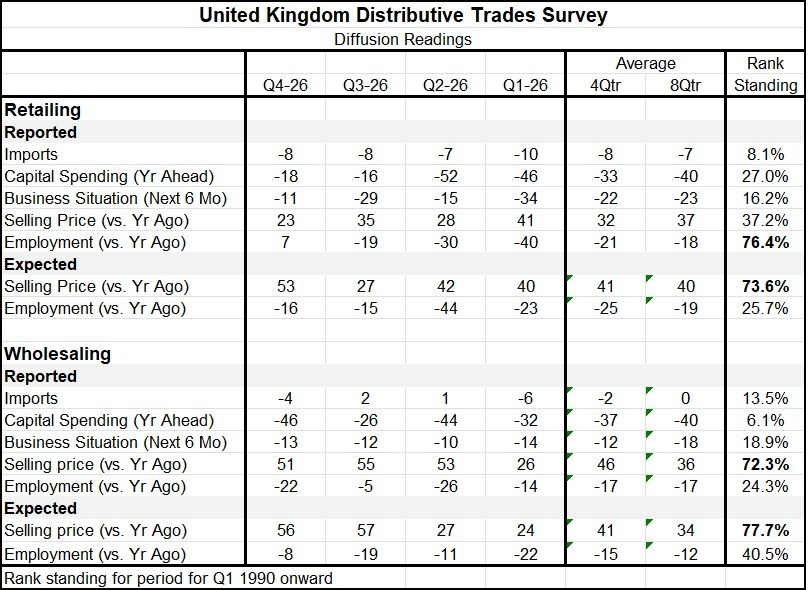
The bottom line for the distributive trades survey is that the inflation picture that we get from this survey is confusing with retailing showing improvement and wholesaling showing deterioration and further expected deterioration. Retailing shows some substantial and somewhat widespread improvement currently and some significant rebounding in categories over four quarters, while there's little evidence of this kind of improvement in wholesaling. Although it was a modest improvement in the retailing business situation assessment over six months, there was also modest improvement in wholesaling. And still both rankings are low in an absolute sense, below their respective 20th percentile mark.
On balance, it's hard to know what to take away from this quarterly survey. It's got a little bit of something for everybody, a little bit of inflation love, a little bit of inflation fear, a little bit of retailing improvement. Both sectors show modest gains in expected business conditions. But on the whole, the rankings of most of the components remain quite low. Although the notable exception is the strong percentile standing for retail employment versus a year ago, that is not something to be dismissed, even with weak expectations for employment in retailing and wholesaling.

Robert Brusca
AuthorMore in Author Profile »Robert A. Brusca is Chief Economist of Fact and Opinion Economics, a consulting firm he founded in Manhattan. He has been an economist on Wall Street for over 25 years. He has visited central banking and large institutional clients in over 30 countries in his career as an economist. Mr. Brusca was a Divisional Research Chief at the Federal Reserve Bank of NY (Chief of the International Financial markets Division), a Fed Watcher at Irving Trust and Chief Economist at Nikko Securities International. He is widely quoted and appears in various media. Mr. Brusca holds an MA and Ph.D. in economics from Michigan State University and a BA in Economics from the University of Michigan. His research pursues his strong interests in non aligned policy economics as well as international economics. FAO Economics’ research targets investors to assist them in making better investment decisions in stocks, bonds and in a variety of international assets. The company does not manage money and has no conflicts in giving economic advice.
More Economy in Brief
 Global