

 Global| Apr 08 2026
To surpass the "shock" following the Iranian revolution, the price of gasoline must reach nearly $7 per gallon
by:Joel Prakken
|in:Viewpoints
On February 28 the US and Israel launched airstrikes on Iran. In retaliation, Iran closed the Straits of Hormuz. By early April the average US price of regular gasoline jumped to $4.11/gallon from $2.93/gallon in February, an increase of 40%.
To put this price shock in historical perspective, I: defined the real price of gasoline as the price index for personal consumption expenditures (PCE) on gasoline (and other motor fuels) over the price index for total PCE; calculated monthly percent changes in this real price of gasoline; weighted each of those changes by the geometric average of the current and lagged monthly shares of nominal gasoline purchases in total nominal PCE; cumulated the weighted price changes from January of 1960 to the present.
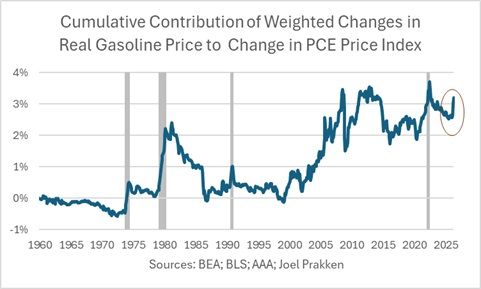
The resulting series (chart) is the cumulative contribution in percentage points of changes in the real price of gasoline to the cumulative change in the price index for PCE. I’ve grey-barred four earlier episodes associated with geopolitical upheaval in the Middle East and Eastern Europe: the OPEC oil embargo in 1973; the Iranian revolution in 1979; the Gulf War in 1990; and the Russian invasion of Ukraine in 2022.
Of course things could get worse, but so far the current shock (circled in chart) falls well short of the shocks associated with either the OPEC embargo or the Iranian revolution because: (1) in percentage terms, the recent increase in the real price of gasoline is smaller than occurred during those episodes; (2) the share of gasoline purchases in total PCE has since fallen in half.
To wit: following the overthrow of the Shaw of Iran in February of 1979, the real price of gasoline rose uninterruptedly over 13 months by 57%. Furthermore, at the start of that episode, gasoline was 3.7% of PCE. In contrast, given secular conservation of energy, by January of this year gasoline was only 1.74% of PCE. Hence today, to take the same bite out of consumers’ real incomes as after the Iranian revolution, the price of gasoline would have to rise by .57*.0366/.0174 = 120%, or to approximately $6.70/gallon. Using similar math, the price of gas would have to reach approximately $4.75/gallon to produce the same hit to consumers’ budgets as following the OPEC embargo.

Joel Prakken
AuthorMore in Author Profile »Joel Prakken is former Chief US Economist of S&P Global and IHS Markit, co-founder of Macroeconomic Advisers, and past president and director of the National Association for Business Economics. He has served as an outside advisor to the Congressional Budget Office, on the Advisory Panel of the Bureau of Economic Analysis, and as a consultant to the Joint Committee on Taxation. He holds a BA in economics from Princeton University and a PhD in economics from Washington University in Saint Louis.