

Nickel, Nationalism and the Future of Indonesia
|in:Viewpoints
Global investment in the energy transition continues to accelerate. The International Energy Agency (IEA) forecasts energy-sector investment will reach US$3.4 trillion this year, up 5%, with advanced economies and China accounting for around 70% of the total. More than US$2.2 trillion will be directed towards renewables, nuclear power, electricity grids, energy storage, low-emission fuels, electrification and energy efficiency.
Renewable power investment alone now totals around US$665 billion annually, while nuclear investment has reached US$80 billion and low-emission fuels US$30 billion.
Electric mobility remains one of the principal growth engines. Global EV sales are expected to reach 21 million vehicles this year, a 20% increase on last year. At the same time, artificial intelligence and data centres have emerged as powerful new sources of electricity demand, particularly in the United States. Investment in data centres has now overtaken global spending on oil supply, with the energy sector contributing US$105 billion of associated investment in 2025—more than the entire energy-sector investment across Africa last year.
The benefits of this investment are already becoming apparent. According to the IEA, a decade of spending on renewables, nuclear energy, electrification and energy efficiency has materially improved energy security while reducing emissions across major fuel-importing economies. In 2025 alone these investments saved China, the European Union, Japan, Korea, Southeast Asia and India an estimated US$260 billion in fossil-fuel import costs. Roughly one-third of the savings came from renewable energy, another third from energy-efficiency gains, around one-fifth from electrification and the remainder from nuclear power.
Nickel and the energy transition
The implications for critical minerals are profound. As governments pursue energy security, artificial intelligence expands, technology costs fall and net-zero policies remain in place, demand for minerals such as lithium, cobalt, nickel, copper, graphite and rare earths will continue to rise. These materials underpin batteries, electricity grids, permanent magnets and increasingly digital infrastructure.
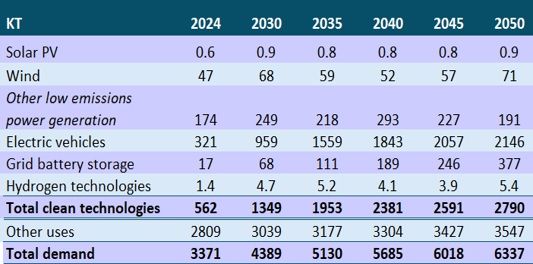
Nickel is particularly well positioned (Figure 1). The IEA projects that global nickel demand will almost double by 2050, with clean-energy technologies accounting for 44% of total demand, compared with just 17% in 2024. Electric
Figure 1: IEA Nickel demand forecasts
Source: IEA World Energy Investment 2026 & Westbourne Research
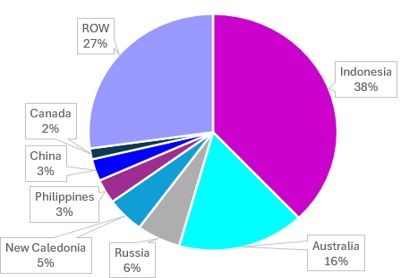
Indonesia is uniquely placed to benefit (Figure 2). The country possesses around 38% of global nickel reserves, comfortably ahead of Australia. Although Indonesia's reserves would last only around 25 years at current production rates compared with more than two centuries in Australia, the commercial opportunity remains enormous.
Figure 2: Nickel reserves
Source: BP Energy Statistical Review of World Energy & Westbourne Research
The real prize lies not simply in mining but in moving further up the value chain—from ore extraction to refining, battery materials, battery production and ultimately electric vehicle manufacturing.
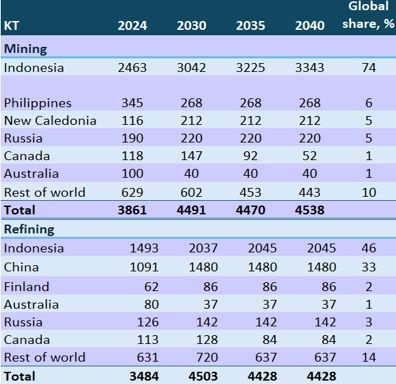
The IEA expects Indonesia's dominance to strengthen further. By 2040 Indonesian nickel mining output is forecast to increase by almost 36%, lifting its share of global production to 74%, up from 64% in 2024. Refined nickel production is projected to rise even faster, giving Indonesia almost half of global refined supply (Figure 3).
Figure 3: IEA Nickel supply forecasts
Source: IEA World Energy Investment 2026 & Westbourne Research
Jokowi's industrial success
Indonesia's emergence as the world's dominant nickel producer was no accident. It was the result of deliberate industrial policy under former president Joko Widodo (Jokowi).
The centrepiece was the ban on nickel ore exports, culminating in a full prohibition in 2020. Combined with generous tax incentives, import-duty exemptions, accelerated depreciation, industrial parks and streamlined licensing reforms, the policy forced investment into domestic smelting, refining and battery materials.
The reforms dramatically improved the investment environment. Bureaucracy was reduced, permitting accelerated and foreign capital flowed in. Between US$30 billion and US$40 billion of foreign direct investment entered Indonesia's nickel processing and battery sectors, much of it from China. Indonesia rapidly transformed itself from a commodity exporter into a critical player in the global battery supply chain.
A more interventionist approach
The policy direction has become less clear since President Prabowo Subianto took office in 2024.
Prabowo has retained Jokowi's downstream industrialisation strategy but favours a much larger role for the state in directing investment and capturing the returns from Indonesia's natural resources.
Four months after taking office he established Danantara, a state investment fund bringing together Indonesia's state-owned enterprises. Initially presented as Indonesia's equivalent of Singapore's Temasek, its mandate has steadily expanded beyond that of a conventional sovereign wealth fund.
In May the government announced the creation of PT Danantara Sumberdaya Indonesia (DSI) to centralise exports of strategic commodities. Initially covering coal, palm oil and ferroalloys, the reforms have since broadened so that, following the transition period ending in August, exports of designated commodities can only be conducted through DSI. From September the state's role will deepen further as DSI oversees contracts, pricing, foreign-exchange receipts and potentially international negotiations.
The government's stated objective is to eliminate transfer pricing, under-invoicing and the leakage of resource revenues overseas. Those are legitimate concerns. However, the reforms also represent a significant increase in state control over commodity markets.
The obvious question is whether the model will eventually be extended to nickel, copper and bauxite.
Markets are becoming nervous
Capital flows towards countries offering attractive risk-adjusted returns, predictable regulation, secure property rights and confidence that profits can be repatriated. Greater state intervention inevitably raises questions over each of these.
The concern is not simply commercial. Prabowo has also committed to ambitious spending programmes, including universal free school meals, subsidies and expanded welfare provision. Investors will worry that Danantara and DSI could ultimately become vehicles for financing politically attractive expenditure rather than maximising long-term economic returns.
Financial markets appear increasingly sceptical. The Jakarta Composite Index has fallen sharply from its December 2025 peak. Foreign direct investment assets declined 10% during the first quarter of 2026, while annualised net FDI inflows dropped 44%.
The deterioration is also evident in our business-cycle indicators. Indonesia remains one of the weakest performers in our latest assessment. The investment cycle continues to deteriorate rather than stabilise, suggesting businesses remain reluctant to commit new capital.
Meanwhile, Bank Indonesia has tightened monetary policy aggressively to stabilise the rupiah. Higher interest rates are arriving just as consumer confidence and household spending weaken. The slowdown in retail sales despite a relatively resilient labour market suggests previous growth was increasingly dependent upon fiscal support rather than private-sector demand.
Investment conclusion
Indonesia possesses extraordinary long-term advantages: abundant critical minerals, favourable demographics and a central position in the global energy transition. Those strengths have not disappeared.
However, realising that opportunity requires policies that continue attracting domestic and foreign capital. Indonesia's success under Jokowi rested on creating incentives for investment while allowing markets to allocate capital efficiently. The current policy direction points towards greater state intervention, increased political influence over investment decisions and rising regulatory uncertainty.
The cyclical outlook is already weakening, while the structural outlook has become more uncertain. Until there is greater clarity over the government's direction, we remain underweight Indonesian assets.

Sharmila Whelan
AuthorMore in Author Profile »The founder of Westbourne Research (www.westbourne-research.com), Sharmila Whelan is a seasoned Global Geopolitical-Macro Strategist with nearly three decades of experience advising buy-side clients on multi-asset investment strategies and asset allocations. Her career has been defined by her differentiated thinking, a deep understanding of the intricate connections between global geopolitics, macro and policy dynamics, and the Austrian business cycle approach to economic analysis. She has counseled governmental bodies such as the CIA, the US State Department, the British High Commission, DFID, and China’s NDRC.
Sharmila has held prominent roles in both London and Hong Kong, serving as Managing Director at Aletheia Capital, Director at Merrill Lynch Bank of America, Senior Economist at CLSA, and Asia Regional Economist at BP Plc. In 2022, Bloomberg recognised her as one of the UK's "12 New Expert Voices." She is a frequent media commentator on Bloomberg TV and radio, BBC World Business News, and CNBC, and is a sought-after speaker at high-profile events such as the Financial Times Wealth Summit and CFA UK & India conferences. Sharmila also contributes opinion pieces to Financial Times Professional Wealth Management and the Economist Group’s EIU.
 Asia
Asia