

 Global| Aug 27 2026
Featured Data Additions, August 27, 2026
Summary
- Additional labor force statistics by age group and sex for North Macedonia were added to the EMERGECW database.
- Central government public debt statistics for Uzbekistan were added to EMERGECW.
- A Danube River water level series for Hungary was added to GLSECTOR, INTDAILY, ENERGY and TRANSPRT.
EMERGECW → North Macedonia → Employment and Earnings → Labor Force by Age and Sex
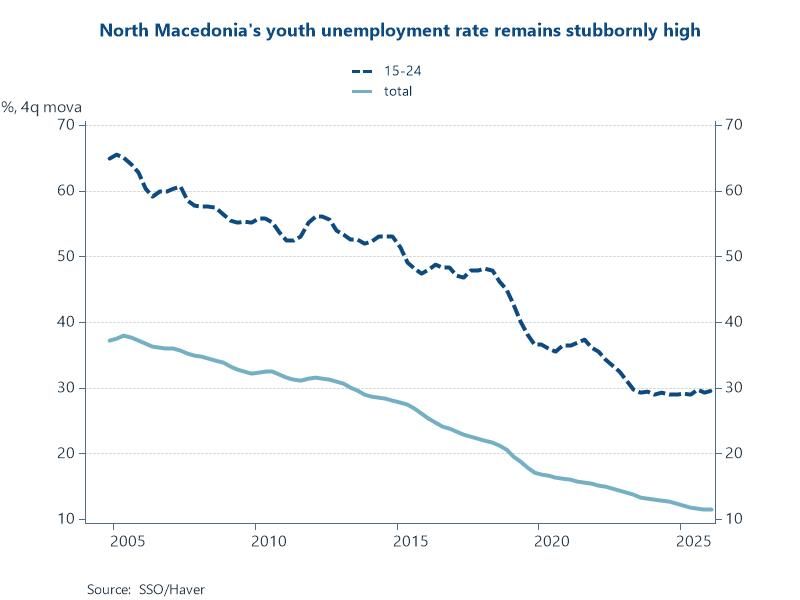
Additional labor force statistics by age group and sex for North Macedonia were added to the EMERGECW database. Data by age intervals were added for participation rates, employment rates, and unemployment rates. Monthly data are sourced from the Republic of North Macedonia State Statistical Office and start in 2017 for most of the new detail.
Chart: The latest Q2 2026 reading shows an unemployment rate of 30.1% (4qma) for the 15-24 year age group in North Macedonia – and it has been hovering there for 3 years. This is significantly high by international standards, as the world average sits around 16.1%, while the European average sits around 15.8%. While youth unemployment has fallen by roughly half from the catastrophic early-2000 levels of 65%, it remains stubbornly high, indicating that despite overall growth, economic reforms and policy initiatives, interconnected structural challenges in the labor market persist.
EMERGECW → Uzbekistan → Public Finance and Debt → Central Government Public Debt
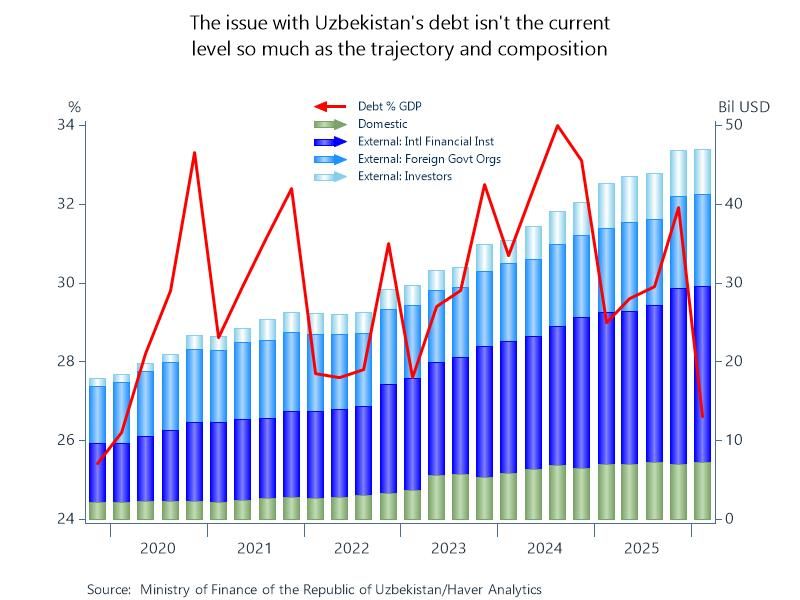
Central government public debt statistics for Uzbekistan were added to EMERGECW. This table includes external and domestic debt available by type of interest rate, currency and maturity. Metrics as a percent of GDP are also included. Quarterly data are sourced from the Ministry of Finance of the Republic of Uzbekistan and start in Q4 2019.
Chart: Uzbekistan's state debt reached 47 billion USD in Q1 2026, of which 85% was external debt. International financial institutions make up the largest share accounting for 56% of the total. Bilateral loans from foreign government financial institutions make up another 29%. The remainder was raised directly from international investors through the issuance of sovereign bonds. The debt ratio sits at 26.6% which is not problematic, but there are concerns about its increasingly heavy external reliance making Uzbekistan vulnerable to exchange rate and external financing shocks.
GLSECTOR → Water Statistics → Hungary → Danube River Water Level at Paks
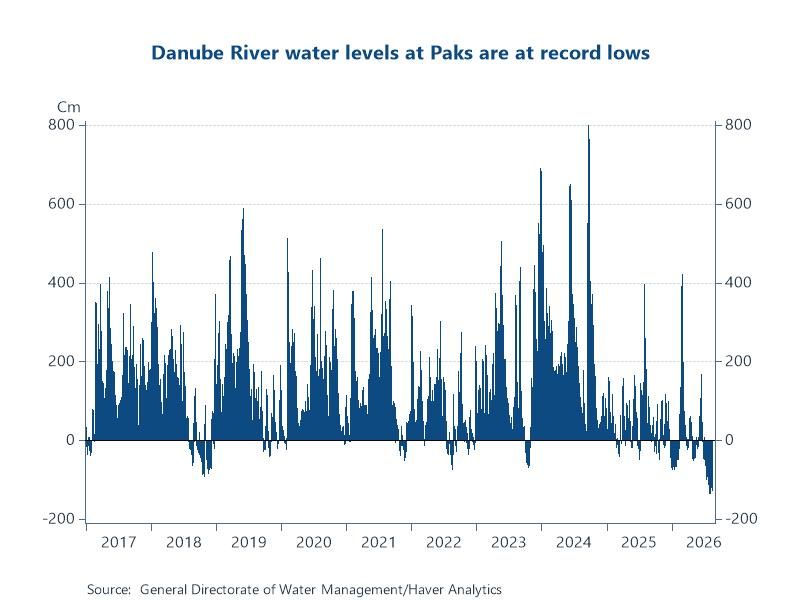
A Danube River water level series for Hungary was added to GLSECTOR, INTDAILY, ENERGY and TRANSPRT. The reading is taken from the location of the Paks Nuclear Power Plant. The series is reported in centimeters relative to a zero reference point. Daily data are sourced from the General Directorate of Water Management and start in January 2002.
Chart: Europe's Danube River has fallen to its lowest levels in more than half a century, disrupting the transport of food, fuel, and industrial goods across the region. The impact is particularly acute for Hungary's Paks nuclear power plant—the nation's sole facility and source of roughly half of its electricity. Low water levels have crippled the plant's cooling system, forcing it to operate at just 25% of capacity. Hungary came perilously close to a complete shutdown last week until engineering work in the river near the plant averted the crisis.
More Featured Data Additions
 Global| Oct 07 2026
Featured Data Additions, October 7, 2026
 Global| Sep 23 2026
Featured Data Additions, September 23, 2026
 Global| Sep 18 2026
Featured Data Additions, September 18, 2026
 Global| Sep 02 2026